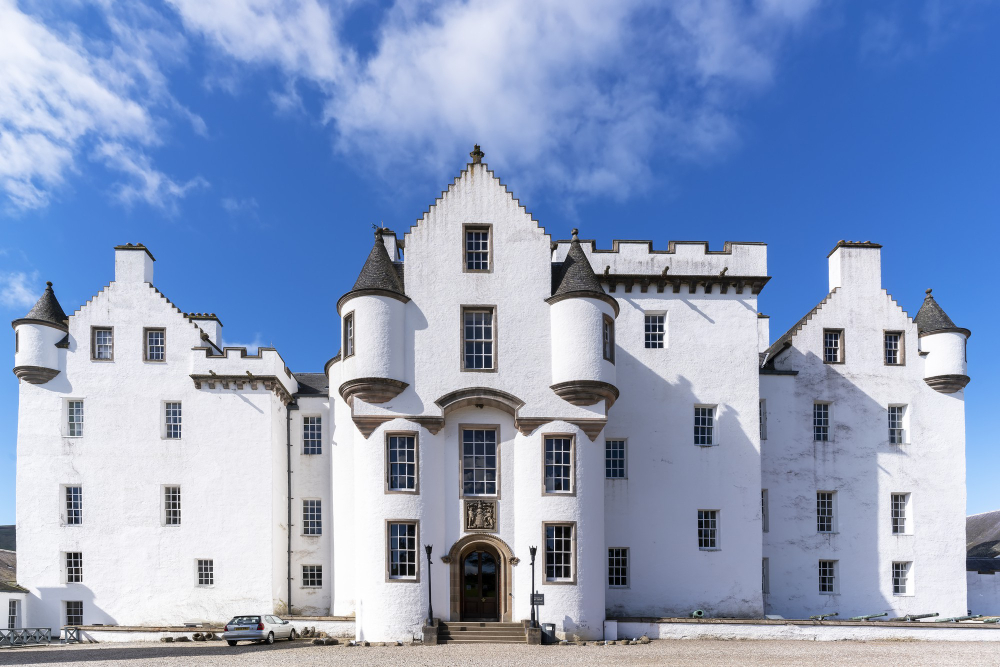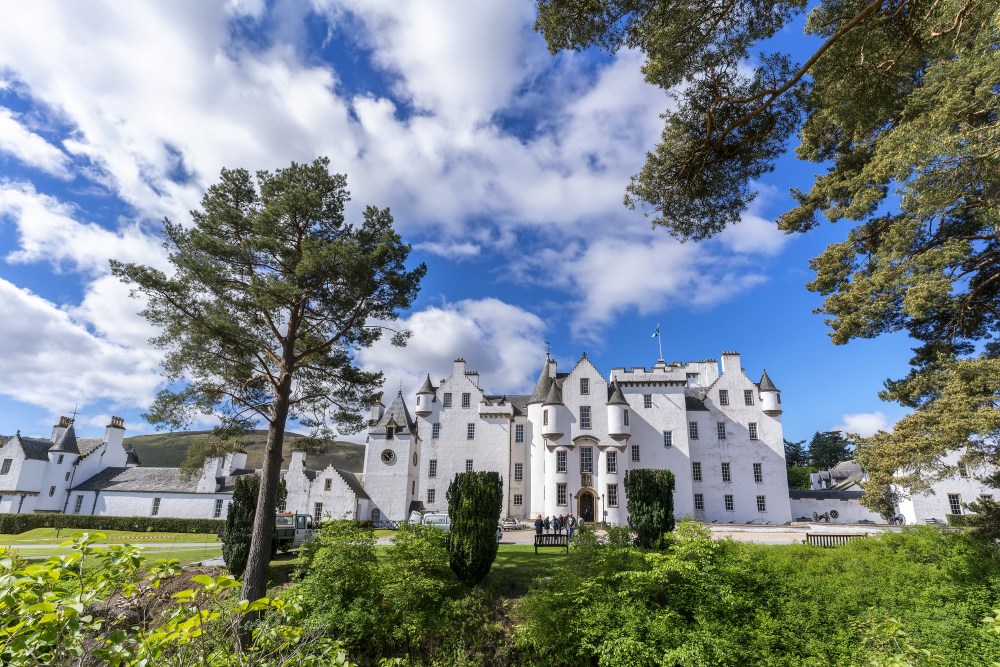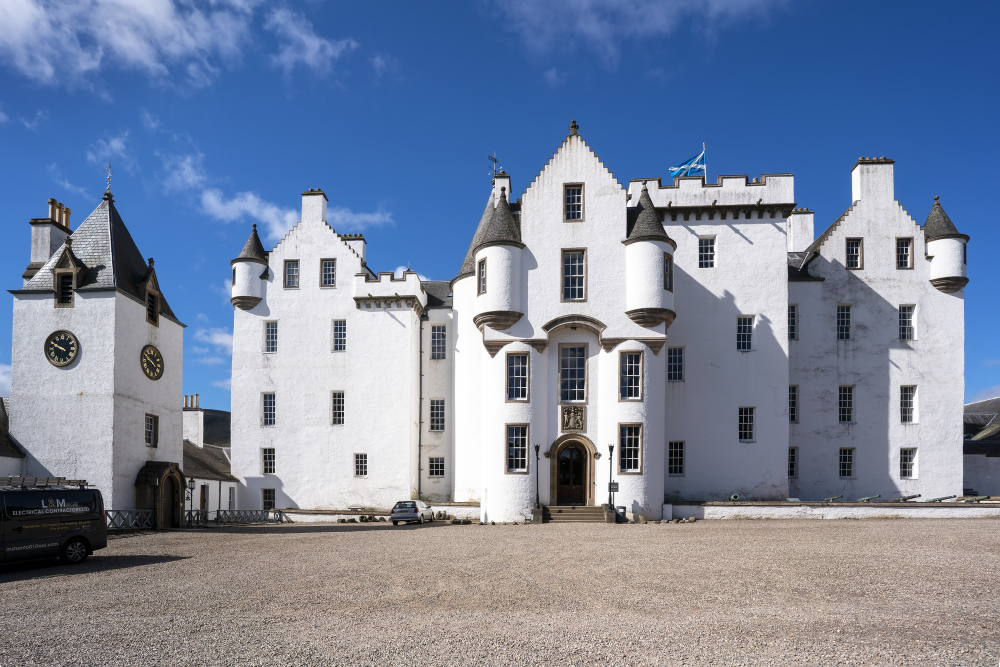
Set amidst the picturesque landscape of the Scottish Highlands lies Blair Castle, an impressive structure that not only reflects the architecture of bygone eras but also bears witness to an eventful and dramatic history. The castle is situated in Blair Atholl in the administrative district of Perth and Kinross and has been closely associated for centuries with the Murray family and their head, the Duke of Atholl. Today, the estate belongs to Bruce Murray, yet its historical and cultural significance extends far beyond its walls. The castle is not only a popular tourist destination but also the setting for fascinating stories and legends dating back to the early Middle Ages.
Origins and early conflicts – The rise of Blair Castle – The origins of Blair Castle date back to the 13th century. It was John Comyn, better known as the ‘Cumming of Badenoch’, who initiated the construction of the fortress in 1269. However, this move immediately led to tensions, as David Strathbogie, the so-called ‘Crusader Earl’, raised objections to the construction. He argued that Comyn had unlawfully built a castle on his land during his absence. The conflict ultimately culminated in David regaining control of the site for the Strathbogie dynasty. At that time, power struggles over land ownership and titles were not uncommon in Scotland, and the history of Blair Castle is a prime example of how political intrigue and personal claims shaped the architecture and use of such structures. The title of Earl of Atholl was established as early as the 10th century and was one of the earliest morma titles, corresponding to a regional leadership position. However, the line of the Celtic Earls of Atholl came to an end in the 13th century, and the title passed to the Strathbogie family. This transition marked a turning point in the region’s history and led to prominent figures such as the ‘Crusader Earl’ shaping its destiny for decades to come.
Changes of ownership and political struggles – In the centuries that followed, control of Blair Castle changed hands repeatedly. A particularly decisive moment occurred in the midst of the Civil War, when John Murray, the then owner and a supporter of King Charles I, was forced to fight against Cromwell’s army. The castle was captured in 1652 and remained under foreign control for a time – an episode that illustrates the volatility of the political balance of power at that time. Particularly noteworthy is the role of Lord George Murray, a prominent Jacobite supporter during the Second Jacobite Rising. In an ironic twist of history, he besieged Blair Castle in 1746 – the family seat of his own relatives. This not only highlights the intra-family conflicts of that era, but is also considered the last siege of a British castle. An event that resonates in Scotland’s collective memory and underscores the strategic importance of castles in politically turbulent times.
From family ownership to trust ownership – The modern chapter in the history of Blair Castle began with George Murray, the 10th Duke of Atholl. Before his death in 1996, he decided to transfer the castle to a trust, as his cousin and successor, John Murray, the 11th Duke of Atholl, had no intention of moving to Scotland from his home in South Africa. Despite the physical distance, John maintained a special connection to the castle and visited the Atholl Highlanders annually, a unique military unit with exclusively ceremonial duties. The Atholl Highlanders are Europe’s only legal private army and symbolise the historic link between the Murray family and Scotland’s heritage.
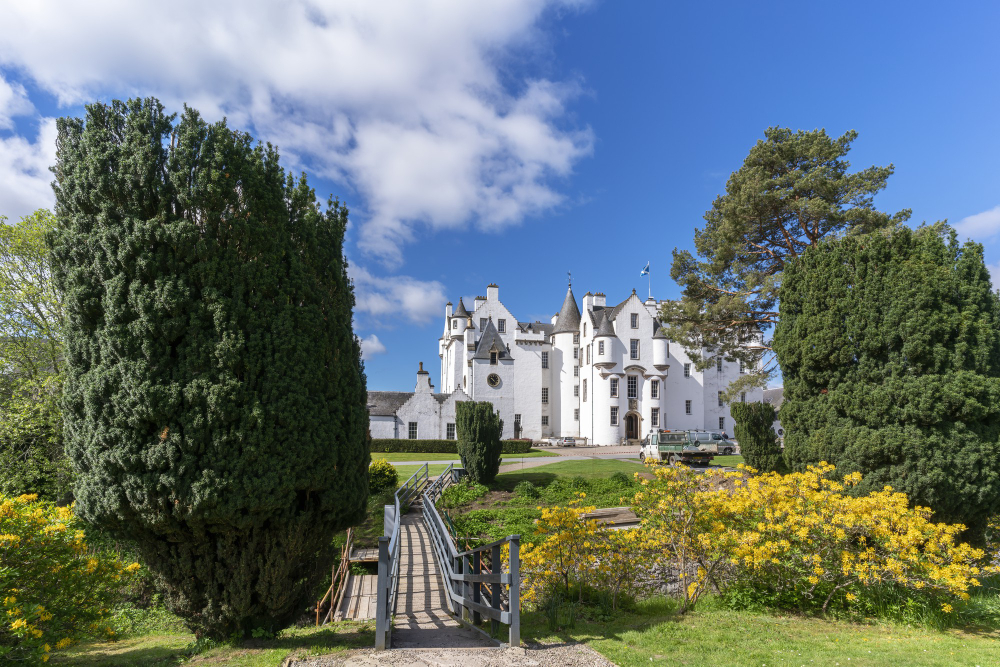
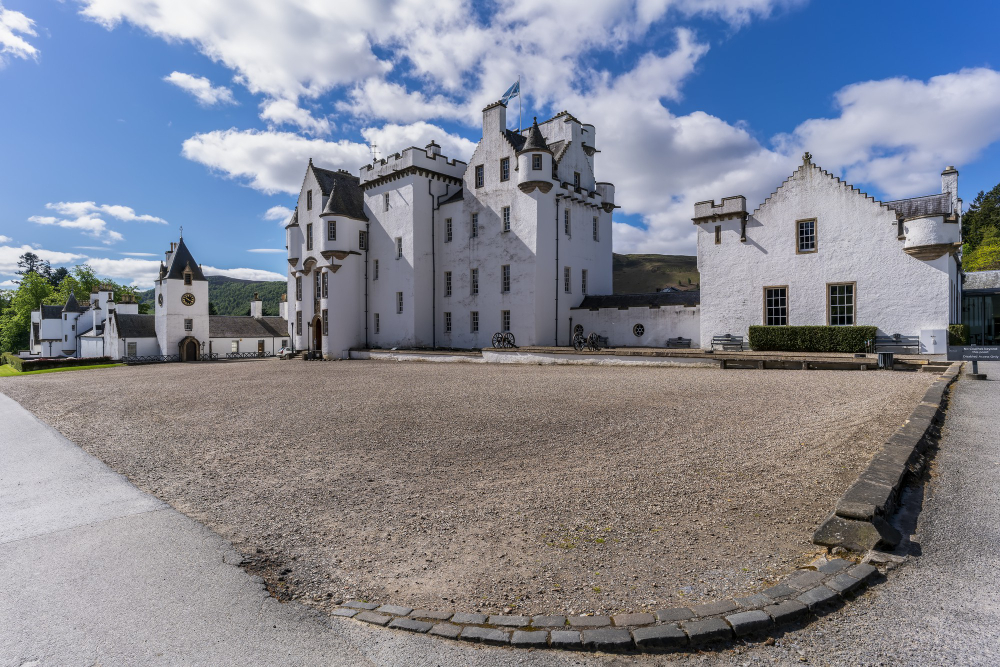
Architectural Features and Transformation – Blair Castle is not only a historical monument but also an architectural masterpiece. Over the centuries, the castle has been rebuilt, besieged and partially destroyed on several occasions. These constant changes reflect the dynamic political and cultural developments of the respective eras. The castle, originally designed purely as a fortress, gradually transformed into a luxurious mansion with a palatial façade. Today, Blair Castle is clad in white plaster, with towers and distinctive stepped gables that give the building its unmistakable silhouette. Inside, the interior is dominated by Rococo stucco work by Thomas Clayton, as well as a series of marble fireplaces designed by Thomas Carter. In the 1860s, the 7th Duke of Atholl had parts of the castle rebuilt in the Baronial style, a project overseen by the architect David Bryce. Particularly noteworthy is the wood-panelled entrance hall, adorned with weapons and highlighting the house’s military tradition.
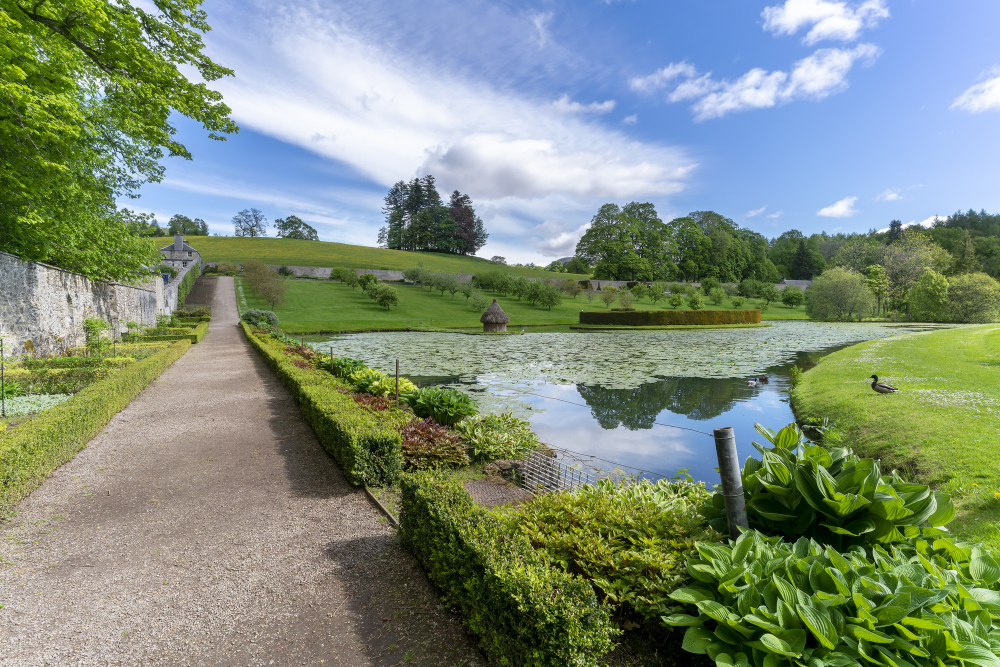
The Gardens of Blair Castle – A natural paradise steeped in history – The extensive grounds of Blair Castle are among the most beautiful gardens in Scotland and were officially listed in the Register of Gardens and Landscapes in 1987. With their magnificent ornamental gardens, a promenade terrace and ornate statues, these gardens also tell their own story. Particular highlights include the sundial and the grotto by the River Tilt, which invite visitors to explore and marvel. The gardens are often used as a venue, including for the appointment of the ‘Keepers of the Quaich’, an exclusive society dedicated to promoting Scottish whisky culture.
Legends and Mysteries – Like many ancient Scottish castles, Blair Castle is shrouded in numerous legends and mysteries. One of the best-known stories is that of the ‘White Lady’, a ghost said to float through the castle’s corridors. Visitors report unexplained noises and mysterious shadows moving in the darkness. Whether truth or myth – such stories lend Blair Castle a mystical aura that attracts thousands of tourists every year.
A living monument to Scottish history – Today, Blair Castle is a place where past and present merge. With its rich history, architectural masterpieces and role as a cultural centre, the castle is one of Scotland’s most significant monuments. It is not only a testament to political power struggles and dynastic intrigues, but also a place of tranquillity and beauty that captivates visitors from all over the world. The stories and legends surrounding Blair Castle make it a fascinating destination for the curious and history buffs alike. The castle’s eventful history shows how human tragedies, political power struggles and architectural advances came together to create an imposing castle that continues to inspire people to this day.