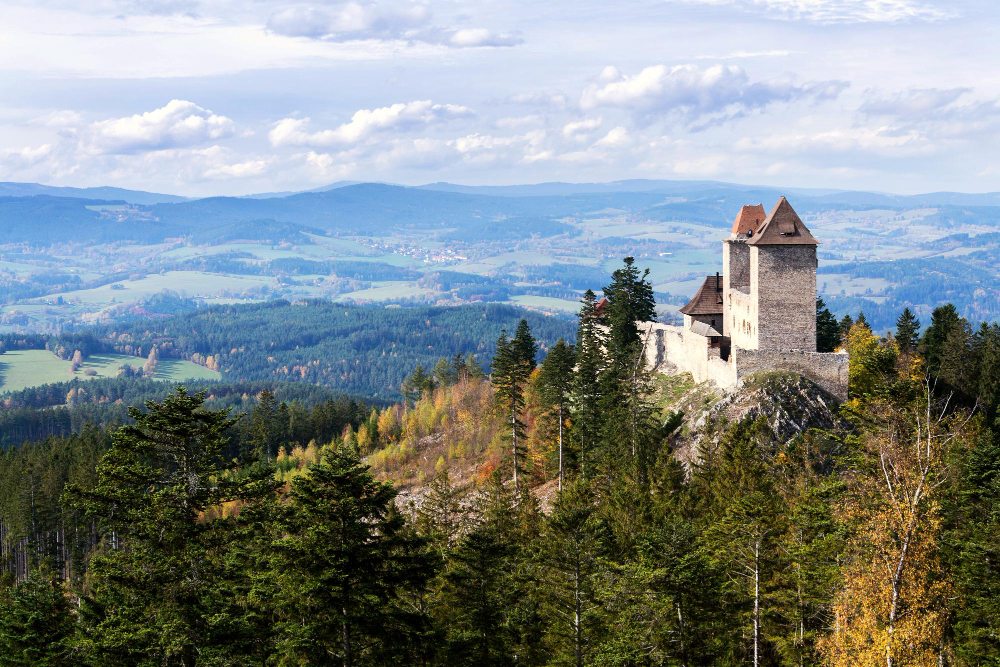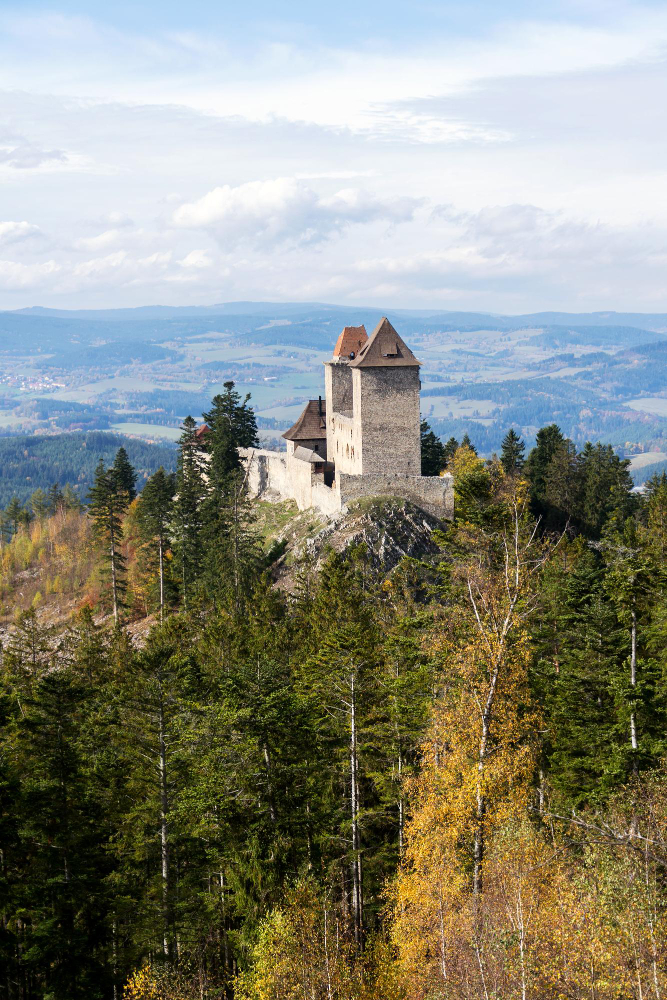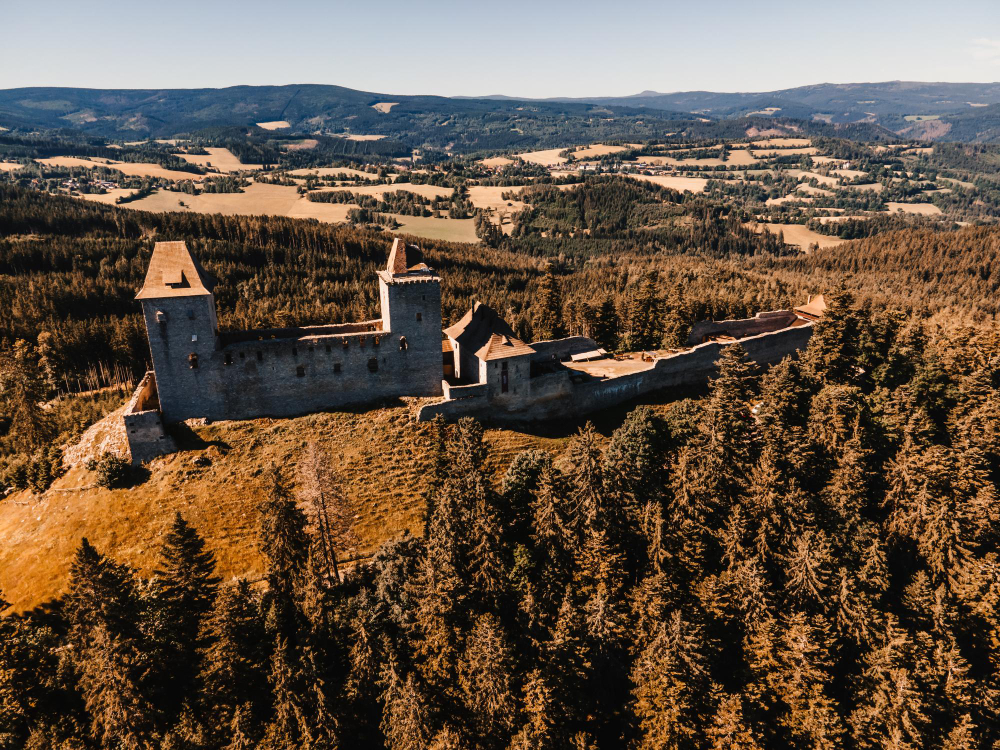
High up in the forests of south-west Bohemia, the imposing silhouette of Kašperk Castle rises to 886 metres above sea level. It is regarded as the highest royal castle in the historic Kingdom of Bohemia and continues to attract history buffs, architecture enthusiasts and hikers alike to this day. Yet it is not only its strategic location and imposing architecture, but also the myths and legends surrounding Kašperk that make it a unique place full of secrets.
Its Founding: Protecting the Border and Controlling the Gold – The castle’s construction dates back to 1356, when it was founded by Charles IV, Holy Roman Emperor and King of Bohemia. At that time, Bohemia faced a twofold challenge: on the one hand, the kingdom had to secure its border with neighbouring Bavaria; on the other, the region around Kašperské Hory was known for its rich gold deposits. The castle was therefore intended to serve both as a military fortress and to control access to these valuable resources. However, there was another important reason for the castle’s strategic location: Kašperk lay directly on the ‘Golden Road’, a major trade route linking Bohemia with Bavaria and the prosperous regions of Western Europe. By building the castle, Charles IV was able not only to guarantee the safety of trade but also to secure revenue from customs duties and commercial transactions. Although Kašperk held the status of a royal castle, no monarch ever resided within its walls. Instead, it was handed over to so-called ‘mortgagees’, who simultaneously assumed administrative and judicial authority in the Prácheň region – an area encompassing a large part of south-western Bohemia.
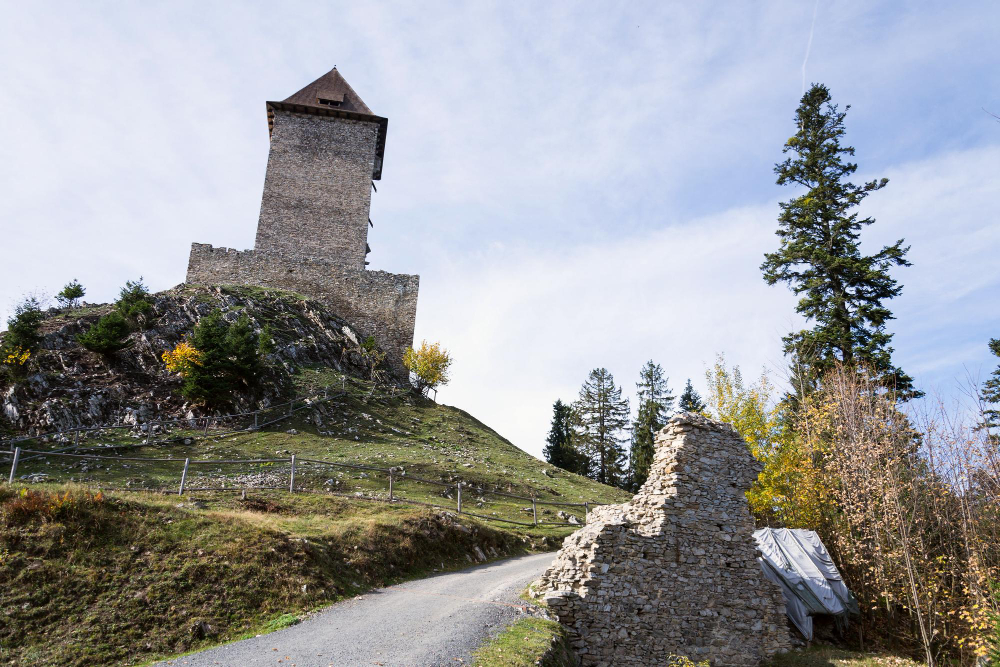
Peace and Unrest: The Castle’s Changing Owners – The first pledgee lords of Kašperk were high-ranking dignitaries: Jan Očko of Vlašim, the second Archbishop of Prague and the first Czech cardinal, oversaw the affairs of the castle and the region. Later, from 1411 to 1454, Kašperk came into the possession of the Zmrzlík family of Svojšín and Orlík. This period was characterised by relative calm and stability. Nevertheless, these owners also left their mark on the political landscape. Peter the Elder, royal master of the mint and a supporter of Utraquism – a religious movement also backed by the Hussites – ensured that the castle remained intact during the Hussite Wars. His son, Peter the Younger, on the other hand, carried out raids into Catholic Bavaria and exploited the castle’s strategic location for his military ventures. In the mid-15th century, Kašperk passed into the possession of the powerful Šternberk (Sternberg) family. Zdeněk of Šternberk, an ambitious and influential member of this family, rose up against King George of Poděbrady in 1465. Suddenly, Kašperk Castle became a stronghold in the political power struggle. To protect the main building from attack, a small defensive structure was erected; its ruins are now known as the ‘Abandoned Castle’ and lie some 400 metres east of the castle.
Legends and mysteries surrounding Kašperk – In addition to its historical significance, Kašperk Castle is also the setting for numerous myths and stories. An old legend tells of three Norns, the goddesses of fate in Germanic mythology, who are said to have lived at the castle. One of the Norns, blind and deceived by her sisters, is said to have lost her fortune. This sombre legend was even mentioned in a 1940 article in the *Donau-Zeitung*. Other stories revolve around hidden treasures and ghosts said to roam the castle’s walls. Visitors report mysterious noises and a strange atmosphere that particularly fires the imagination at night.
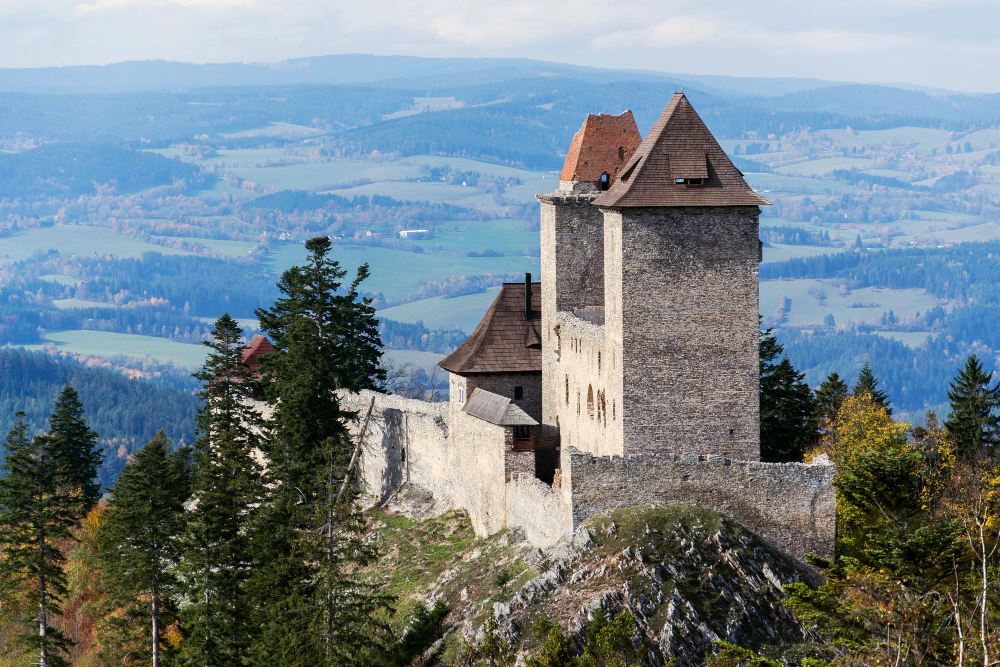
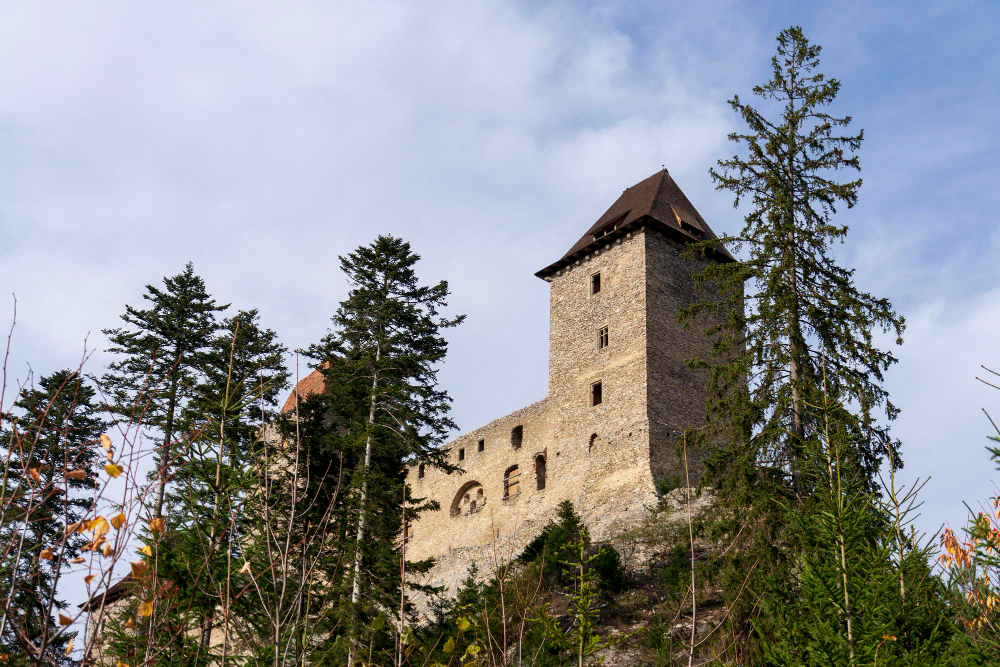
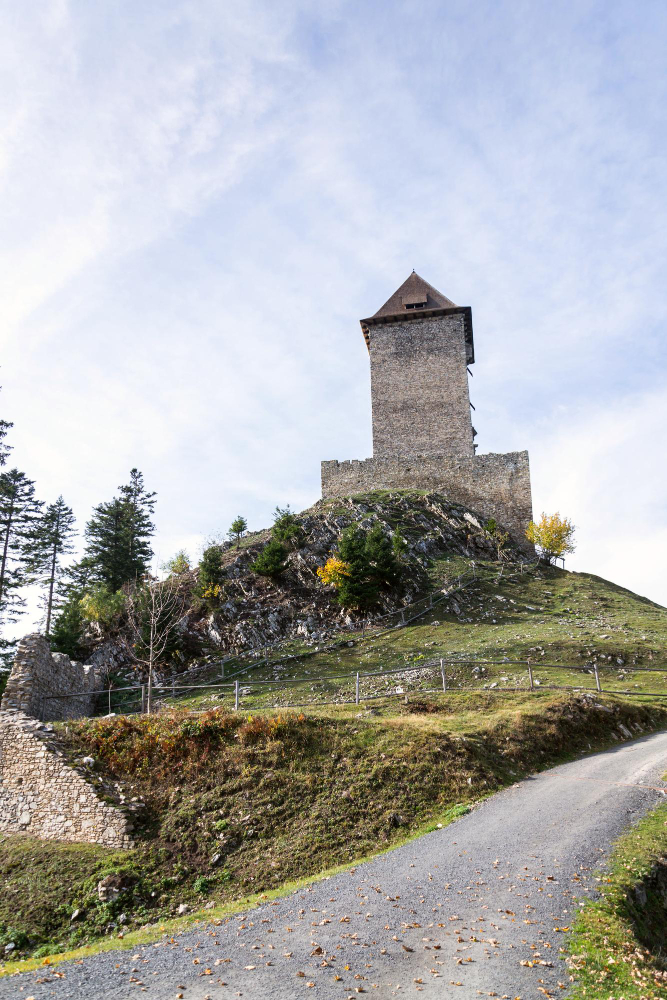
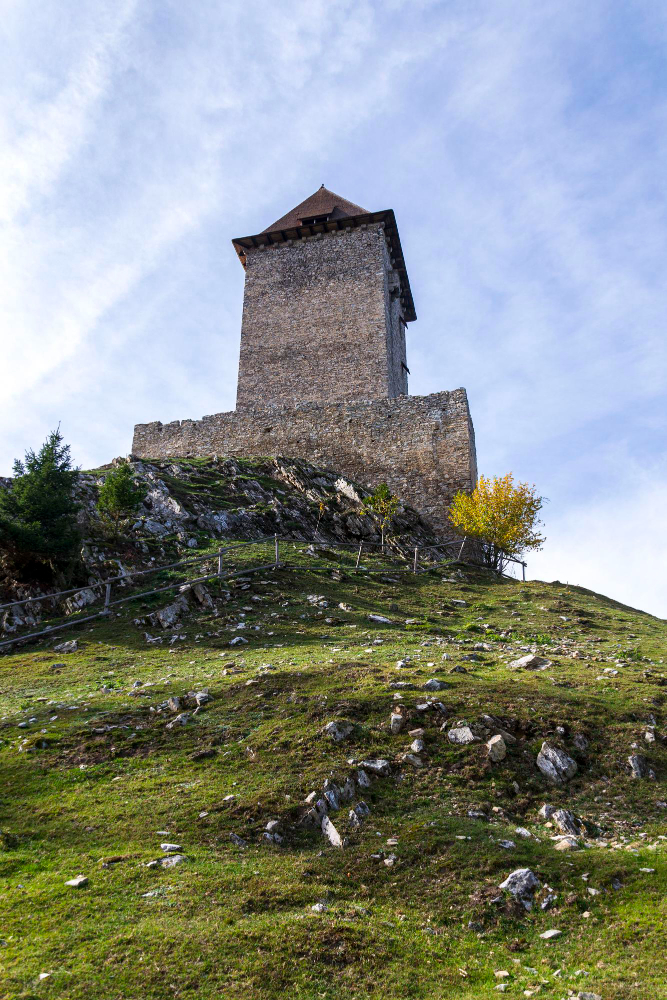
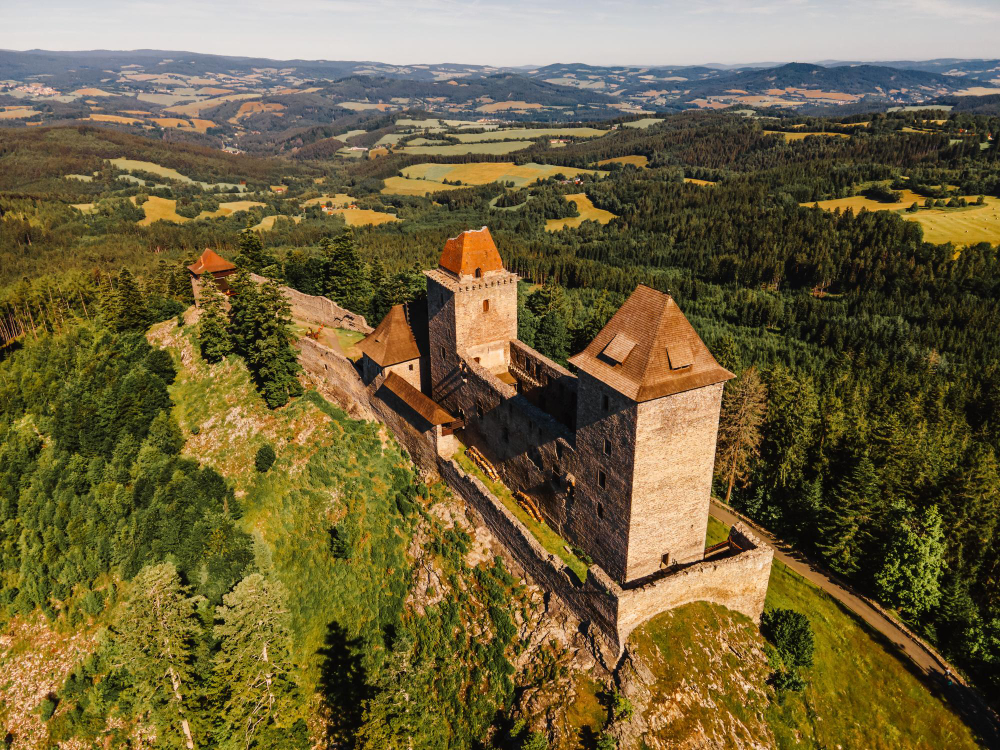
Architecture: A bulwark against attackers – The architecture of Kašperk Castle follows a clear principle: security and defence. The main building consists of two residential towers and an elongated Great Hall built between them. Particular attention was paid to the design of the towers. Their front walls, almost 30 metres high, were deliberately constructed without windows or other openings – only a bay window in the west tower breaks through the otherwise fortified façade. This construction method made the castle particularly resilient to attacks. Furthermore, the central part of the castle was built set back from the outer walls, so that intruders first had to overcome the outer defences before they could reach the vulnerable core.
Getting there and its significance today – Today, Kašperk Castle is a popular destination for walkers and tourists. There is a car park around 1,200 metres away, and the path to the castle leads through the picturesque villages of Kašperské Hory and Nezdice. Numerous hiking trails criss-cross the surrounding area, and the castle is also easily accessible by public transport – the nearest railway station is in Sušice, from where buses run to Kašperské Hory. The castle has been managed by the town of Kašperské Hory since 1616 and has retained its original splendour. It serves not only as a historical monument but also as a venue for cultural events, guided tours and exhibitions.
Kašperk – A place steeped in history and mystery – Kašperk Castle combines everything that makes a medieval castle so fascinating: strategic importance, impressive architecture and an air of mystery. From its foundation by Charles IV, through the turbulent times of the Hussite Wars, to the Šternberk uprisings, it has always been the scene of significant events. And last but not least, it is the stories and legends that keep Kašperk alive to this day. Whether you wish to explore the castle’s history, hidden treasures or historical significance in greater depth – Kašperk remains a place where the past and the imagination merge.