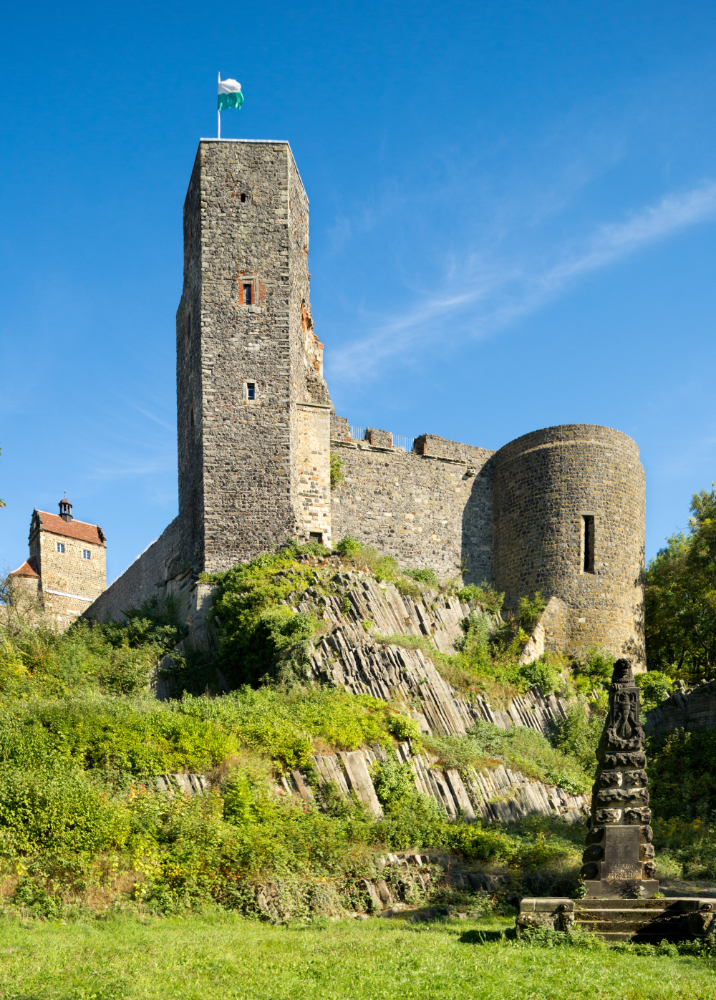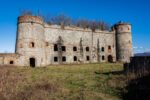
Stolpen Castle, now one of Saxony’s best-known attractions, stands majestically atop a basalt hill some 27 kilometres east of Dresden. Its eventful history stretches back well over a millennium and reflects its transformation from a medieval fortress, through a fortified seat of power, to a romanticised ruin. In addition to its historical significance, the castle also fascinates visitors with its geological features and the legend surrounding Constantia von Cosel, one of the most tragic figures in Saxon history.
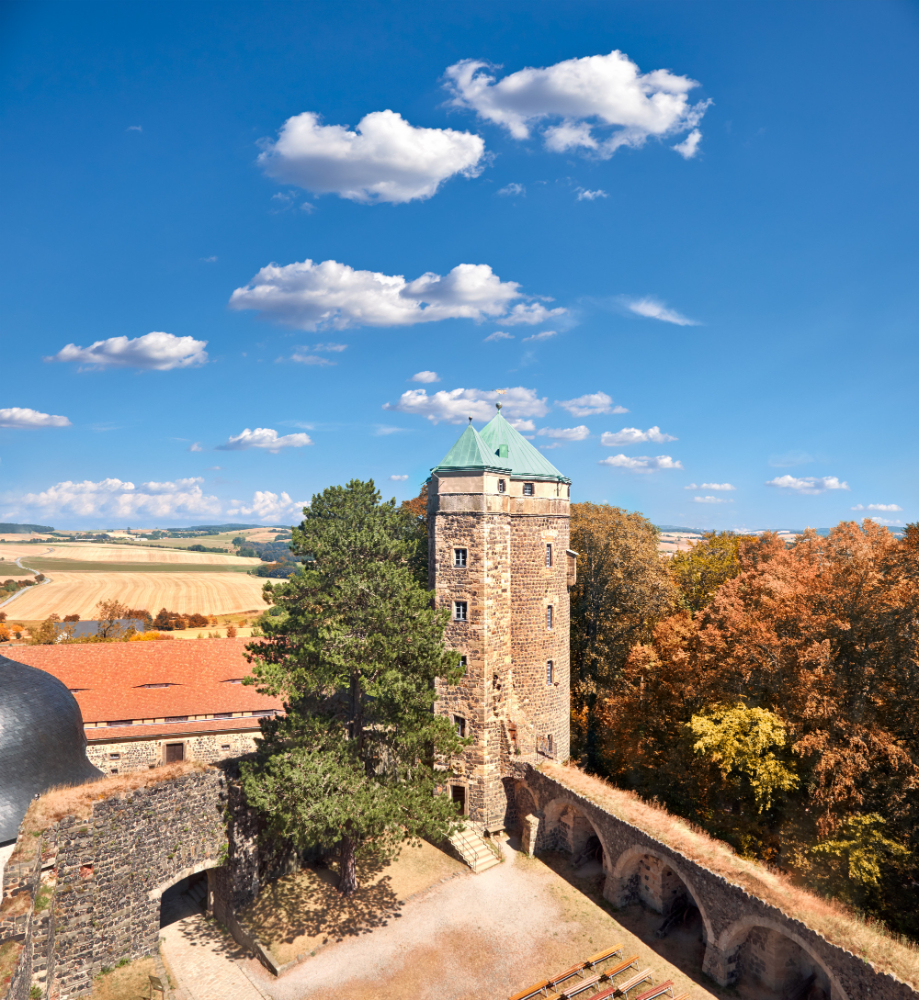
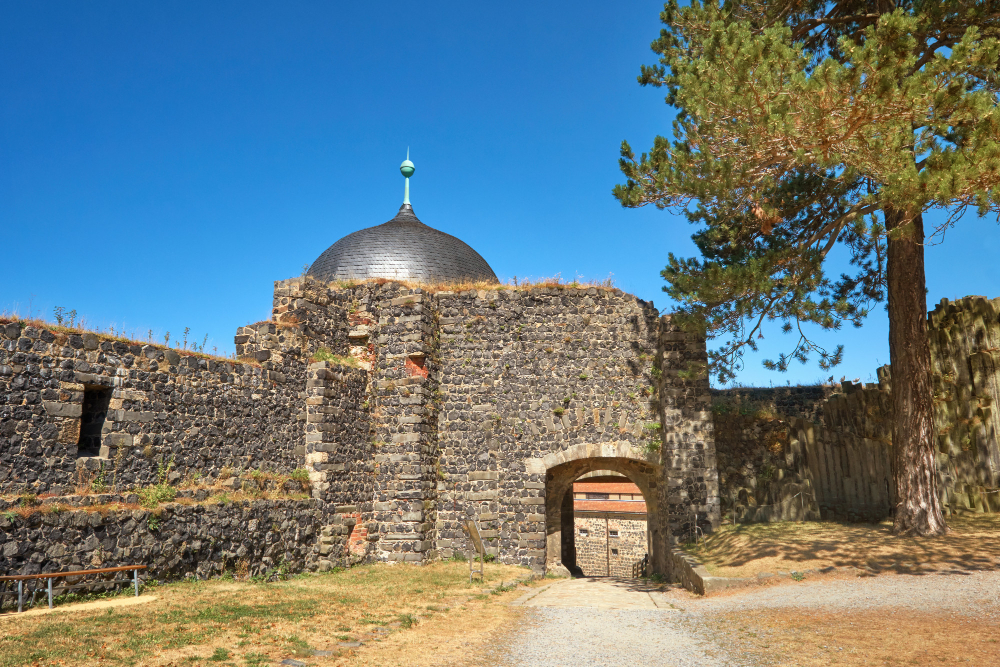
Origins and first written references – The strategically favourable location of the basalt hill, nestled in the border region between the Margraviate of Meissen and the Sorbian settlement areas, made it a sought-after site from an early stage. As early as around the year 1100, there are initial, albeit uncertain, references to a fortification. A decisive moment in its early history was the transfer of the fief of Stolpen to Bishop Bruno II of Porstendorf in 1218, which marked the beginning of its systematic development into a manorial estate. Four years later, the castle was mentioned in a document for the first time. Thanks to the regional availability of robust basalt, work began on the construction of the complex using this durable material – a feature that characterises its appearance and, at the same time, demonstrated its stability. In the 15th century, Stolpen gained enormous significance when the Bishops of Meissen expanded the castle into their principal residence. Among other structures, the towering Johannisturm, the Schösserturm and the granary were erected; the latter served both as a storehouse for payments in kind and as a stable. During the Hussite Wars, the fortress withstood an eight-week siege in 1429, underscoring the strength of its fortifications.
From an episcopal to an electoral residence – A turning point in the castle’s history occurred in 1559, when it was taken over by Elector August of Saxony. Its strategically favourable location prompted him to commission extensive renovations of the complex in the Renaissance style. The result was a fortified palace with magnificently furnished living quarters, as well as a menagerie and an arboretum. During this period, a water-lifting system was also installed to ensure the water supply to the castle, which was situated on a hill – a technical masterpiece in which water was pumped upwards from lower-lying springs with the aid of a large wheel. Yet despite its strategic design, the castle was not spared destruction. During the Thirty Years’ War (1618–1648), it was besieged on several occasions and sustained damage, partly from marauding troops and partly from fires. The resilience of the defenders was, however, particularly evident during the Croatian siege of 1632 and the Swedish attacks of 1639. After the war, however, the castle’s military significance gradually began to wane. Stolpen also became the scene of military clashes during the Seven Years’ War (1756–1763), which shook Europe. After it had been temporarily captured by Prussian troops, parts of the castle were razed to the ground to prevent its reuse as a fortress. Despite being recaptured on several occasions, the complex never regained its former importance and fell increasingly into disrepair.
A Countess in Captivity: The Legend of Constantia von Cosel – One of the most colourful and, at the same time, most tragic aspects of the castle’s history is inextricably linked to Constantia von Cosel. As the mistress of Augustus the Strong, she initially led a life of splendour, but fell out of favour following a political rift. At Christmas 1716, Cosel was taken to Stolpen, where she spent the last 49 years of her life – under conditions that initially resembled strict confinement, but which were relaxed over time. Eventually, she was allowed to move about freely within the palace. Cosel’s later residence, the Johannisturm – which from then on was popularly known as the ‘Coselturm’ – still offers a glimpse into this era today. Her death in 1765 brought her extraordinary life story to an end, but her grave in the now-ruined castle chapel keeps her memory alive.
The slow decline and the Romantic rediscovery – From the 18th century onwards, the castle fell into increasing disrepair as it had finally lost its military significance. Napoleonic troops caused further destruction in 1813, and large parts of the complex were abandoned. It was not until the Romantic period in the 19th century that attention turned once more to the Middle Ages, reviving Stolpen as a place of historical and tourist interest. Restoration work, carried out from 1859 onwards under King Johann of Saxony, ensured that significant parts of the castle were preserved. Particularly noteworthy is the basalt well, whose depth of 84 metres still serves to demonstrate to visitors today the impressive technical capabilities of that era. In the 20th century, the castle was specifically developed for tourism. As a result, its ruins served not only as a popular destination for day trips but also as a backdrop for film scenes. Since 1992, the site has been under the care of the Free State of Saxony, which transformed the former fortress into a modern castle complex. Museums and events have enriched the cultural offering ever since.
A geological wonder: the basalt hill – The geological composition of the Stolpen basalt hill is just as fascinating as its history. The angular columnar basalt, which can be seen in several places around the castle, bears witness to the hill’s volcanic origin. Although it was long assumed to be a classic lava dome, more recent studies have revealed that the hill is a maardiatrem volcano filled with cooled lava. The Stolpen basalt was also the first of its kind to be scientifically described. Researchers such as Georgius Agricola and Johann Wolfgang von Goethe played a key role in shaping our understanding of this rock. Today, the basalt hill is regarded as one of Germany’s most significant national geological sites.
A place steeped in history and natural wonders – Stolpen Castle is far more than a historical attraction; it is a place where history, geology and legends converge. Whether as the former residence of the Bishops of Meissen, as a Renaissance castle of the Wettin dynasty, or as a prison for Constantia von Cosel – every era has left its mark. At the same time, the basalt hill itself harbours stories dating back millions of years, further enhancing the charm of this special place. Today, visitors to the castle experience not only imposing ruins and restored buildings, but also an eventful past that transports them into the world of the Middle Ages, the power struggles of the Baroque era and the longings of the Romantic period. The history of Stolpen is an invitation to explore the connection between humanity and nature, rule and resistance, decay and reconstruction – an experience that goes far beyond a mere sightseeing tour.