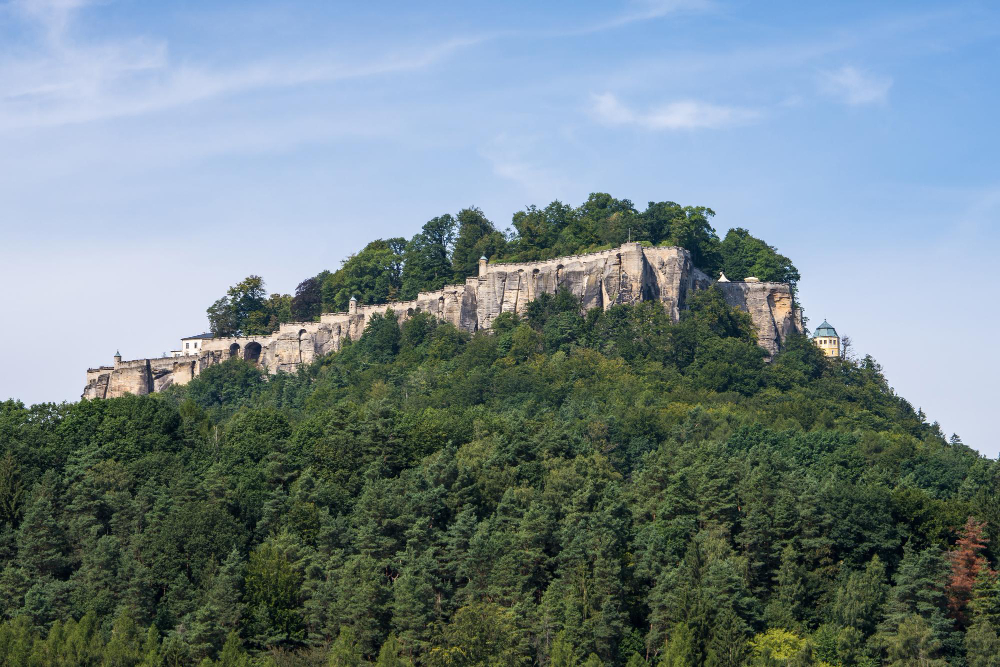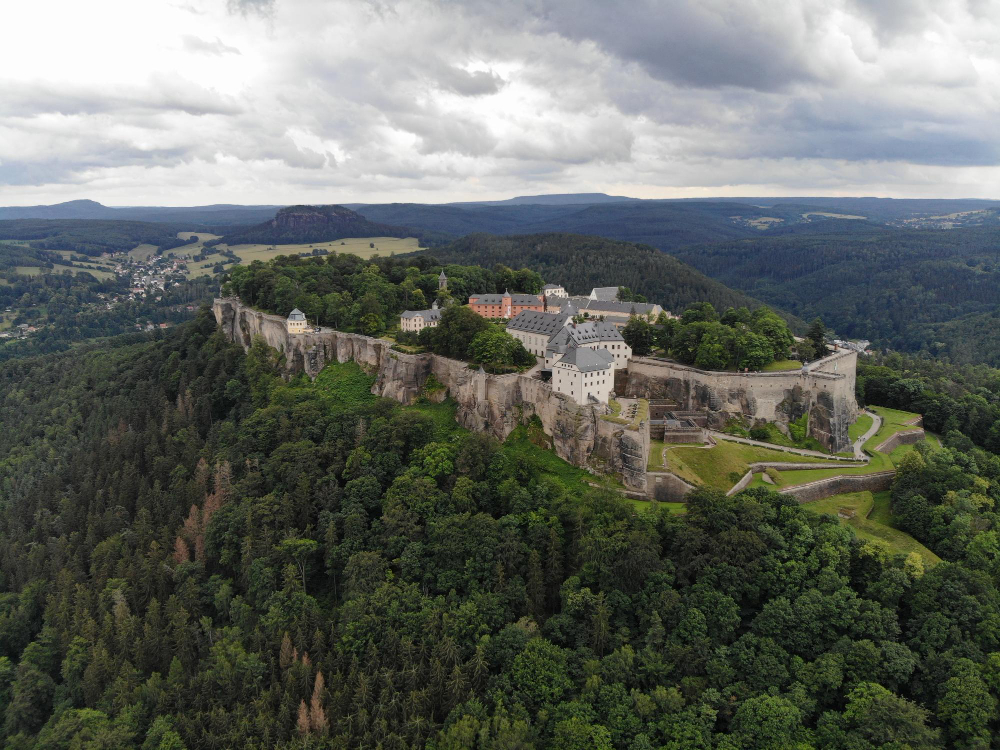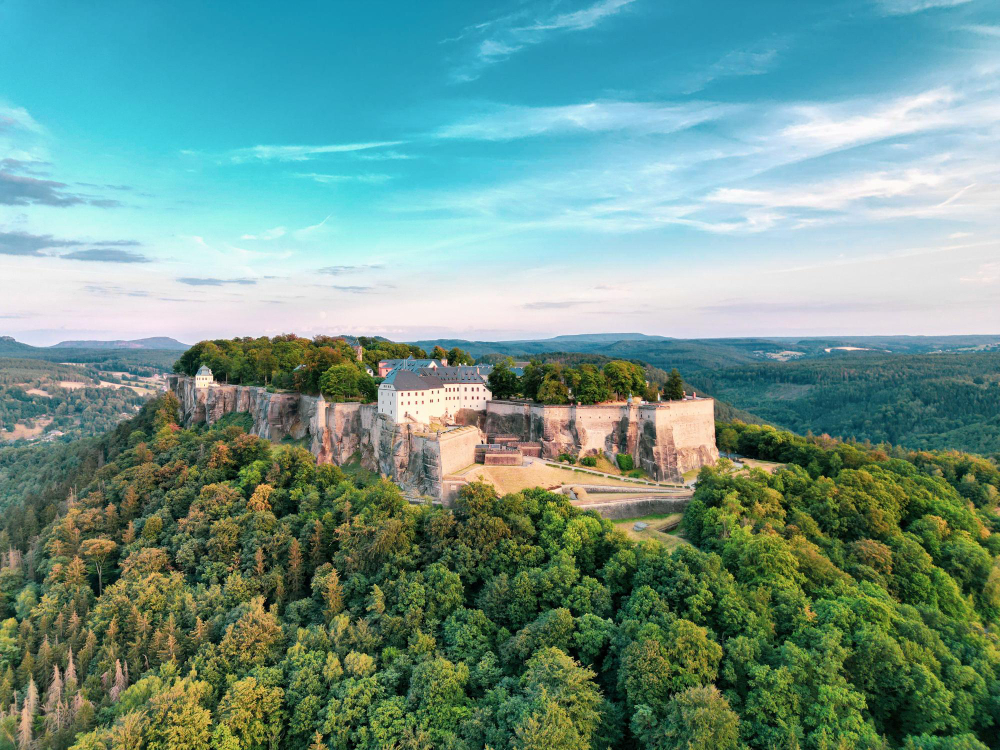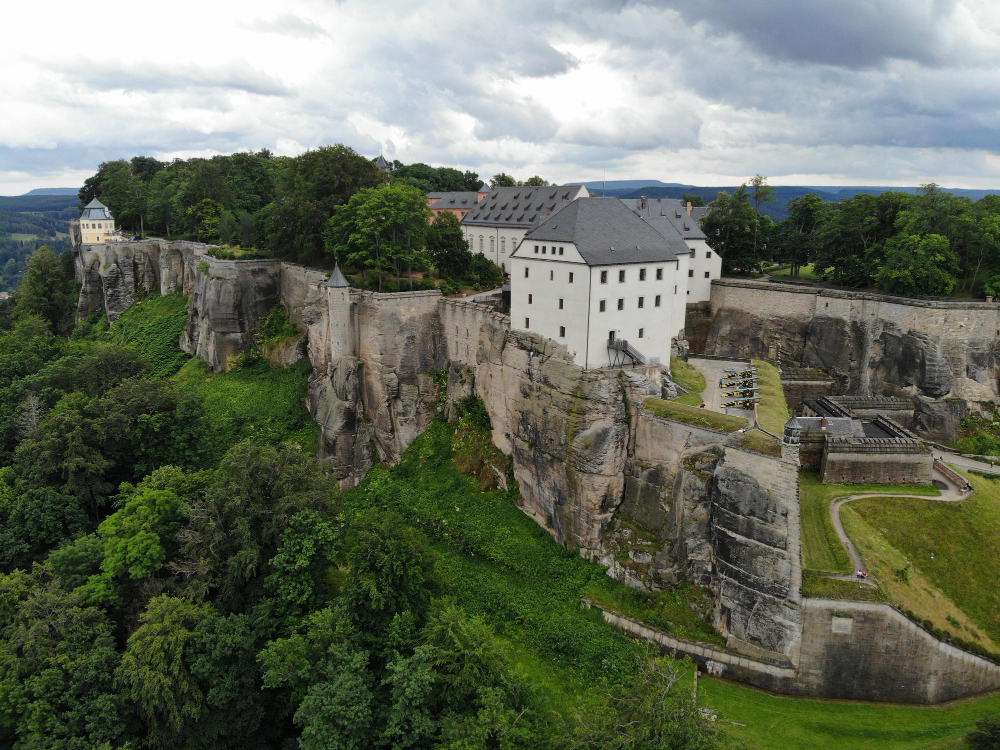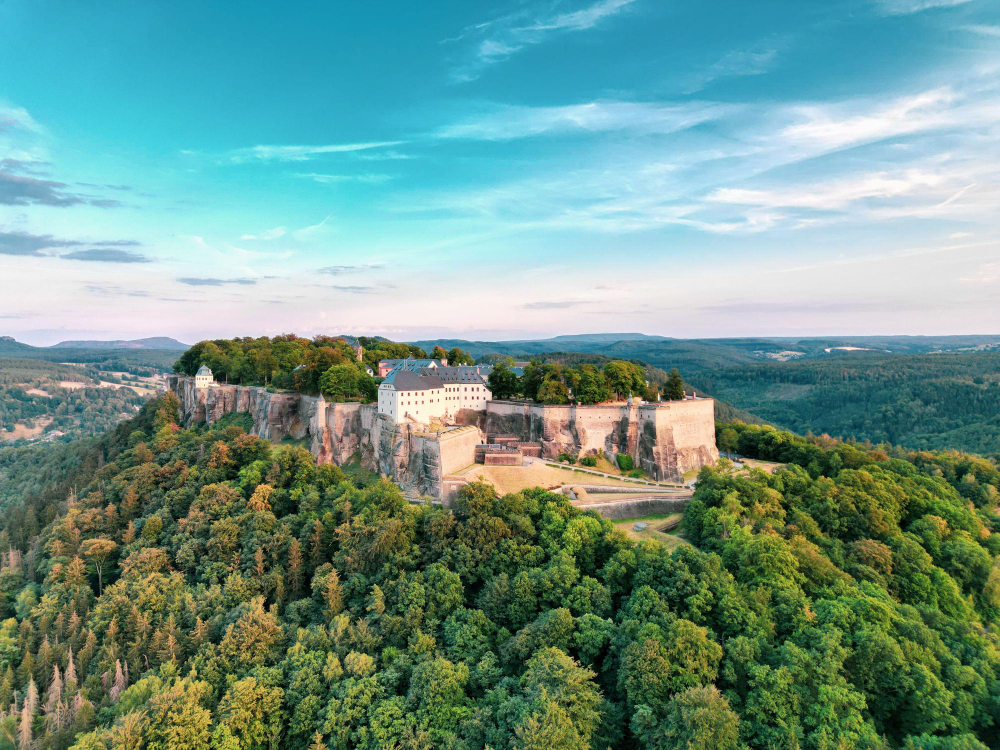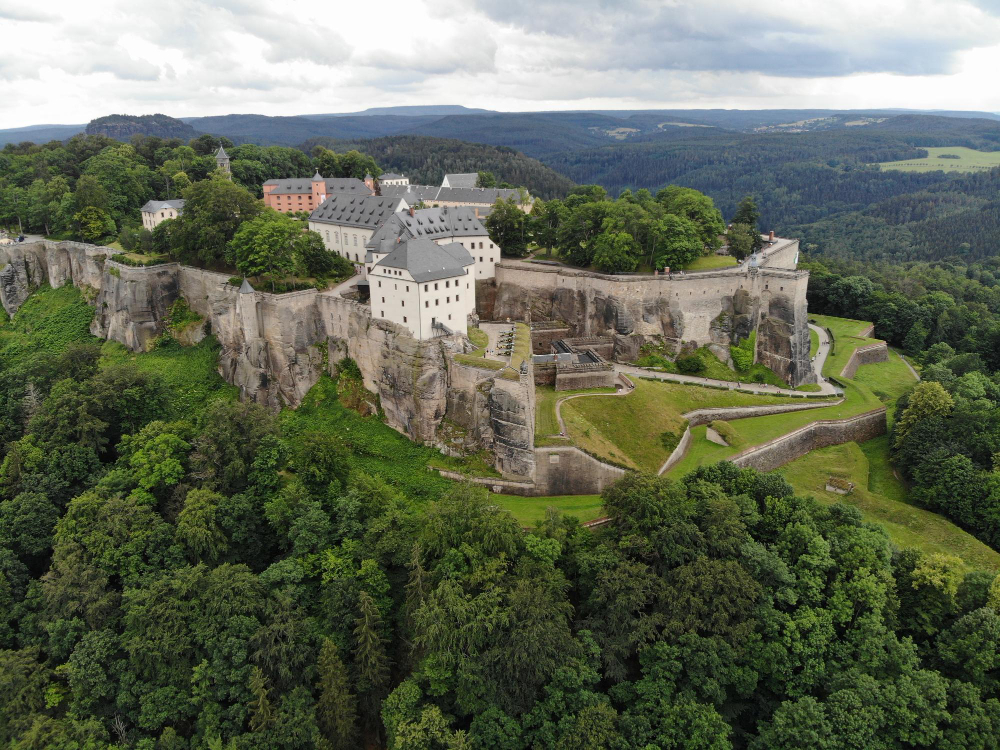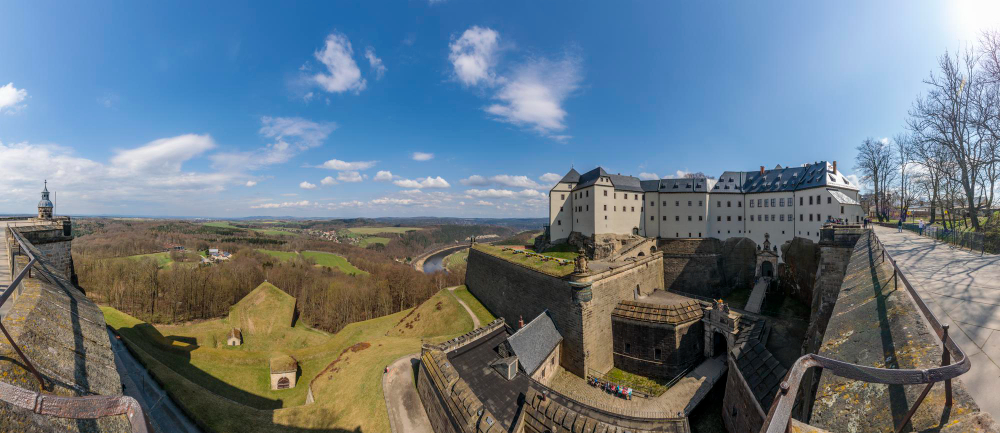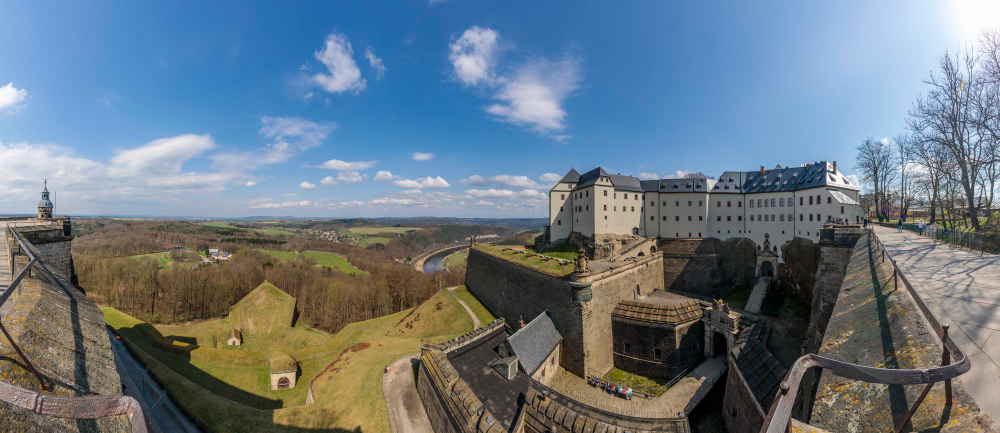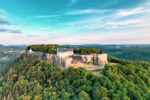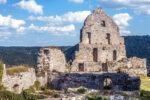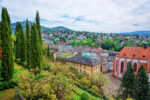
Nestled deep within the picturesque Elbe Sandstone Mountains, Königstein Fortress towers high above the River Elbe – an extraordinary structure that is not only one of the largest mountain fortresses in Europe, but has also held unmistakable significance for Saxony and its eventful history over the centuries. On a 9.5-hectare rocky plateau, rising 240 metres above the left bank of the River Elbe near Königstein in the district of Saxon Switzerland-Eastern Ore Mountains, lies a complex of more than 50 historic buildings which, as a living museum, now offers a unique insight into historic defensive architecture, military strategies and life in a fortress.
Historical roots: From a Late Bronze Age settlement to a medieval hilltop castle – The history of Königstein begins long before its first documented mention: archaeological finds provide evidence of settlement on the plateau as early as the Late Bronze Age. However, its actual military use began at the end of the 11th century with the construction of a hilltop castle in the north-west of the rocky plateau. The earliest confirmed written mention dates from 1233, when King Wenceslaus I of Bohemia named a ‘Burgrave Gebhard vom Stein’ as a witness in a document. The name ‘Königstein’ was first used in 1241 in the Upper Lusatian Border Charter, which settled the boundaries between Bohemian possessions and those of the Bishop of Meissen. This strategically situated castle served the Bohemian rulers as an important outpost for controlling the northern border region and securing navigation on the Elbe, which was one of the most important trade routes at that time. In the 14th century, Königstein was pledged as security on several occasions and, as a result of regional conflicts, passed into the hands of various noble families on multiple occasions. The Dohna Feud (1385–1408) was particularly significant; during this period, the Margraviate of Meissen finally conquered the castle. It was not until the Treaty of Eger in 1459 that the current border between Saxony and Bohemia was established and Königstein became definitively Saxon.
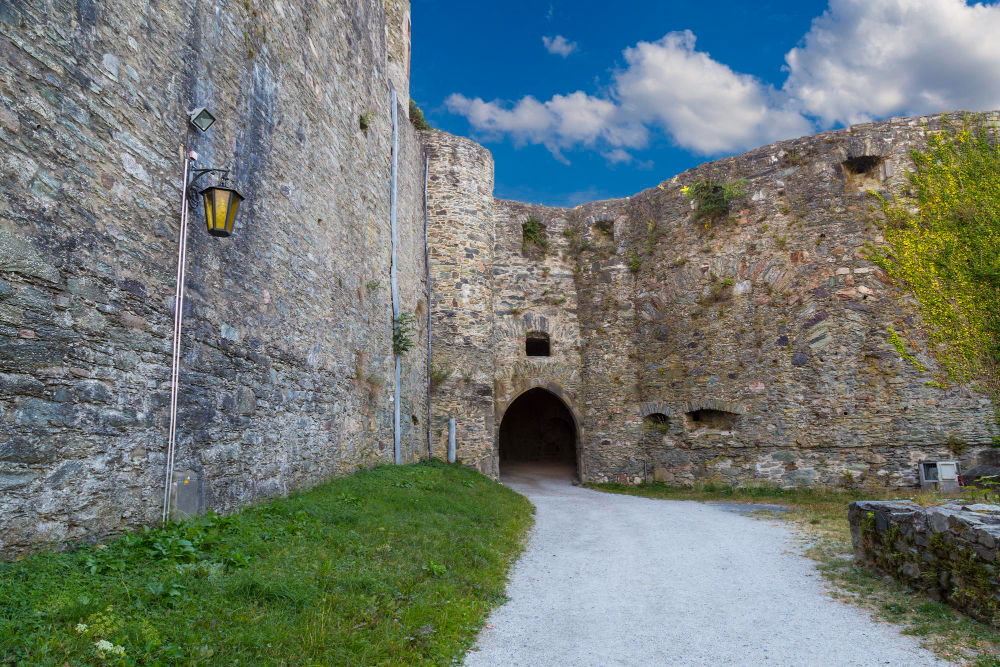
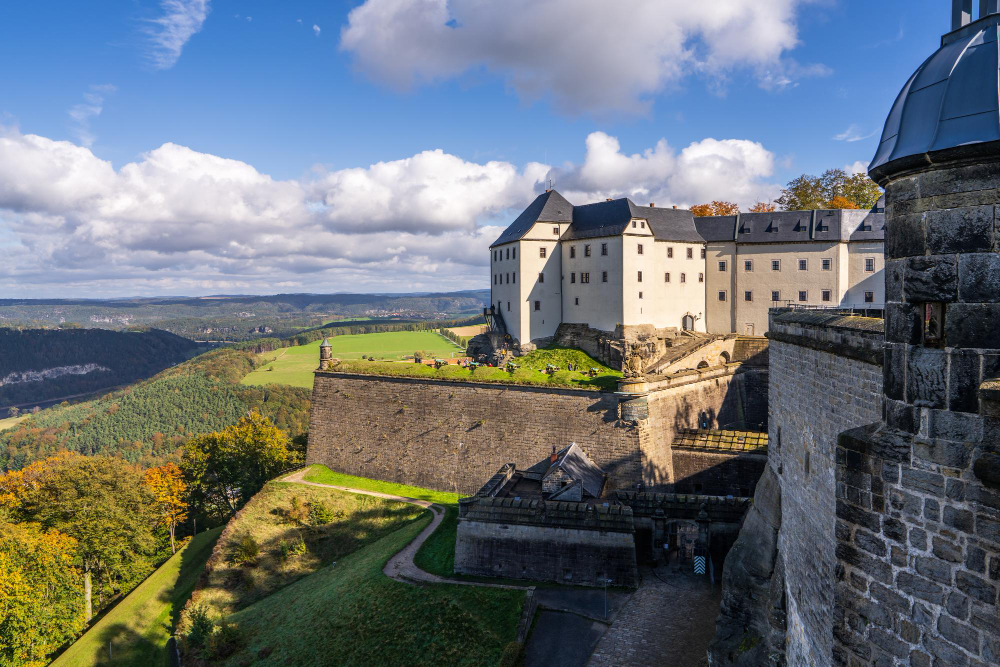
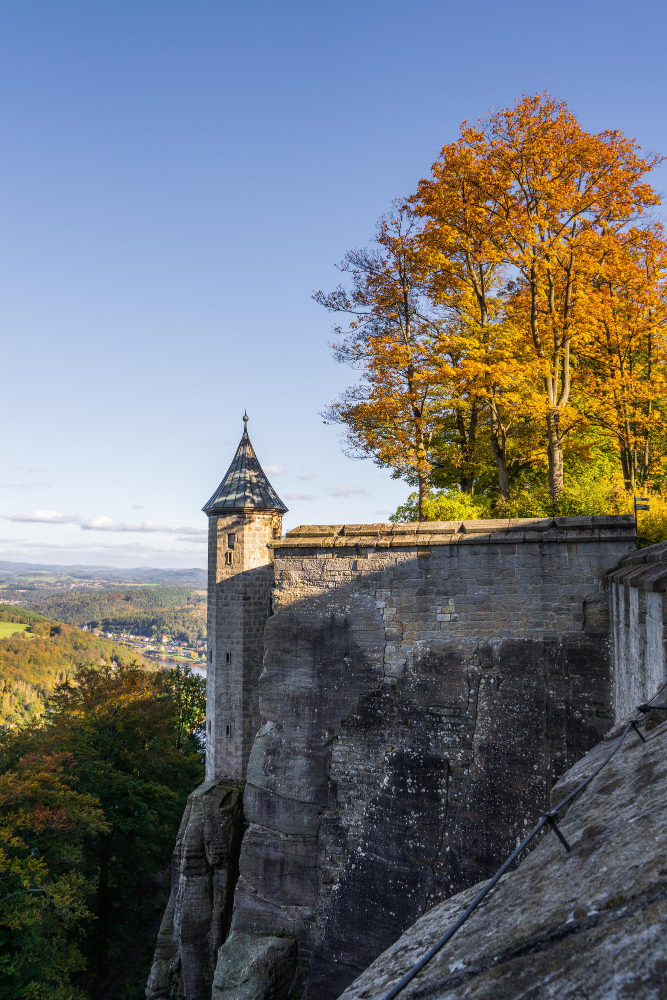
From medieval castle to Renaissance fortress – The medieval castle formed the foundation for a major expansion and redesign from the second half of the 16th century onwards. In 1516, Duke Georg the Bearded founded a Celestine monastery on the plateau; however, this lasted only a few years, as Saxony soon turned to the Reformation. An important milestone for the fortress was the construction of the well between 1563 and 1569: under the supervision of Conrad König, a shaft of an incredible 152.5 metres’ depth was driven into the rock – to this day, it remains the second-deepest castle well in Europe after the Kyffhäuser Well. This extraordinary well enabled the garrison, for the first time, to secure survival supplies independent of rainwater. The effort required to construct it was enormous, as several thousand litres of water had to be pumped out daily in order to penetrate further into the depths. Between 1589 and 1597, under Elector Christian I of Saxony, work began on expanding the complex into Saxony’s strongest fortress. The electoral quartermaster, Paul Buchner, played a key role in the structural extensions by encircling the Tafelberg with a 1.8-kilometre-long rampart. These impressive walls reach a height of 42 metres in places and are further protected by sandstone cliffs. The complex was fitted with tall watchtowers as well as modern defences and casemates for firearms, which were only just beginning to gain importance in military technology at that time. In addition, prestigious building complexes were constructed, such as the gatehouse with its striking three-winged façade, the drawbridge for better defence of the entrance, and two pleasure pavilions for court gatherings – the Christiansburg (now Friedrichsburg) and the pleasure pavilion on the so-called ‘Königsnase’. These buildings combined military functionality with courtly splendour, transforming the fortress into the Elector’s pleasure palace.
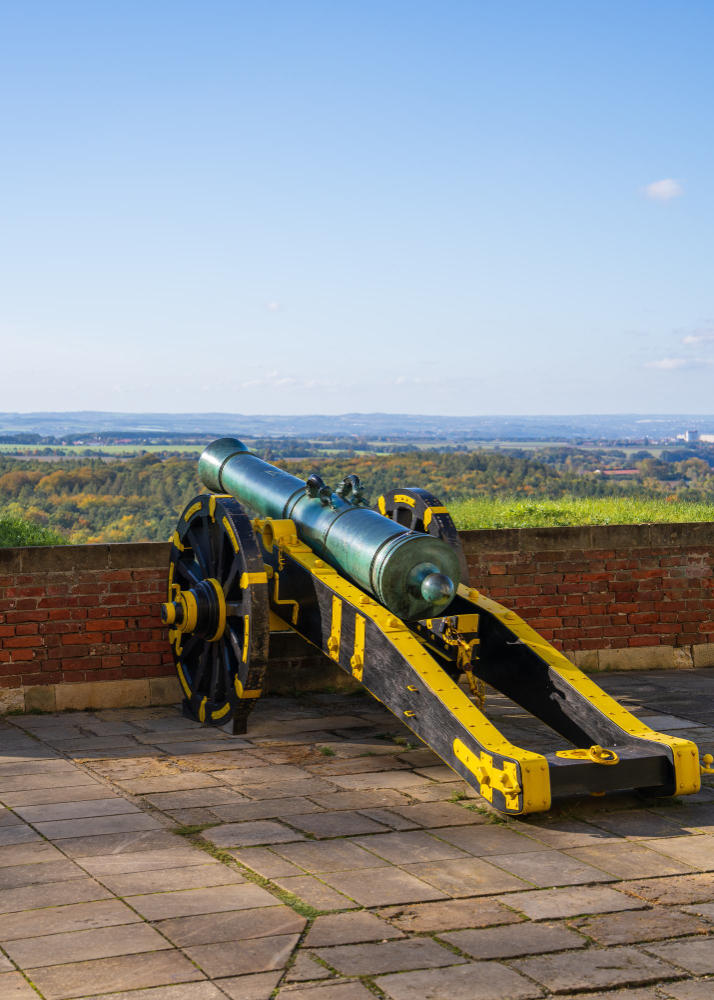
Baroque refinements and adaptations in the 18th and 19th centuries – Following the devastating Thirty Years’ War, further expansion work was carried out to improve the fortress’s defensive capabilities. Between 1667 and 1669, Wolf Caspar von Klengel constructed the Johann-Georgen Bastion. In the decades that followed, the fortress increasingly evolved into a combination of a military stronghold and a courtly palace with Baroque state rooms. Particularly fascinating is the legendary Königstein wine cask, which Augustus the Strong had built in the cellars of Magdalenenburg between 1722 and 1725. With a capacity of almost 250,000 litres, it was the largest wooden cask of its time and bears witness to the Saxon court’s penchant for luxury, even though it was only ever filled to the brim with wine on one occasion. In the 19th century, the fortress lost its role as a residence and was gradually adapted to new military requirements: barracks replaced pleasure palaces, ammunition depots were expanded, and from 1870 onwards the complex was integrated into the German Empire’s fortification system with additional battery ramparts and gun emplacements. Nevertheless, it was never attacked or captured militarily.
The fortress as a safe haven and notorious prison – Although Königstein was never stormed during combat, the fortress held a different kind of significance: at times, it served as a state prison for prominent prisoners and political detainees. Famous figures such as Nikolaus Krell, August Bebel, Mikhail Bakunin and Johann Reinhold von Patkul spent years of their imprisonment here – the isolated casemates and cells provided a setting for intrigues, suffering and fates that continue to fascinate to this day. During the Franco-Prussian War and both World Wars, the fortress also served as a prisoner-of-war camp (Oflag IV-B) for officers of various nations. Particular stories surround the escape attempts of French generals such as Henri Giraud, who was imprisoned here from 1940 to 1942. After the Second World War, the Soviet Army used the site as a military hospital, before it served as a youth work camp during the GDR era, where politically undesirable young people were ‘re-educated’.
From military stronghold to museum: the tourist renaissance from 1920 onwards – With the end of its military significance following the First World War, the fortress gradually opened its doors to the public. The first visitors arrived as early as the 1920s to explore the monumental complex. From 1955, Königstein was designated a museum – a move that enabled the preservation and restoration of many historic buildings.Today, Königstein Fortress stands as one of Europe’s most significant open-air museums of military history. Visitors can walk along the mighty defensive walls, explore the casemates, discover the art of weaponry in the old barracks and enjoy spectacular views over the Elbe Sandstone Mountains on panoramic lifts. Since 2015, the permanent exhibition ‘In lapide regis – On the King’s Stone’ has taken visitors on a journey through nearly 800 years of history, combining architectural highlights with historical artefacts that bring to life the interplay of power, war, culture and everyday life at the fortress. This impressively demonstrates how a simple hilltop castle developed into a complex fortress complex that reflects the changing military strategy and political circumstances in Saxony.
Fascinating legends and unique architecture – The legends surrounding the fortress reflect the mystical aura that has enveloped it for centuries. Tales are told of treasures said to be hidden in the deep well, of the ghosts of former fortress commanders, and of secret escape routes which, to this day, have only been partially explored. Architecturally, Königstein is particularly impressive due to the symbiosis of natural rock formations and human engineering – imposing sandstone walls merge with massive defensive ramparts, whilst historic towers such as the Seigerturm or the Johann-Georgen Bastion dominate the landscape. This combination of nature and architecture makes the fortress a unique cultural monument that attracts visitors from all over the world.
A living monument to history – Today, Königstein Fortress stands as a symbol of centuries-old European history, of the spiritual power of the site and of architecture that has successfully adapted to the rugged terrain. Its use as a museum allows visitors to experience the past first-hand whilst enjoying the beauty of Saxon Switzerland from a breathtaking vantage point.With half a million visitors annually – a large proportion of whom come from Poland and the Czech Republic – the fortress makes a significant contribution to regional development and cross-border cultural exchange. The Free State of Saxony’s ongoing investment in its preservation and modernisation safeguards the future of this unique monument.
A masterpiece of fortress architecture and a treasure of Saxon historyKönigstein Fortress is far more than just a former military complex – it is a monument to European history, a reflection of sovereign power, art and conflict resolution, as well as a place full of secrets and stories that still fascinate today. From its earliest beginnings as a medieval castle to its current role as a museum, it tells of people’s destinies, technical innovations and the eternal quest for security and freedom. Visitors to the fortress do not merely enter an architectural masterpiece; they are immersed in a living history book that chronicles centuries of Saxon and European history whilst offering views of a stunning landscape – an experience that touches the soul deeply and lingers long in the memory.