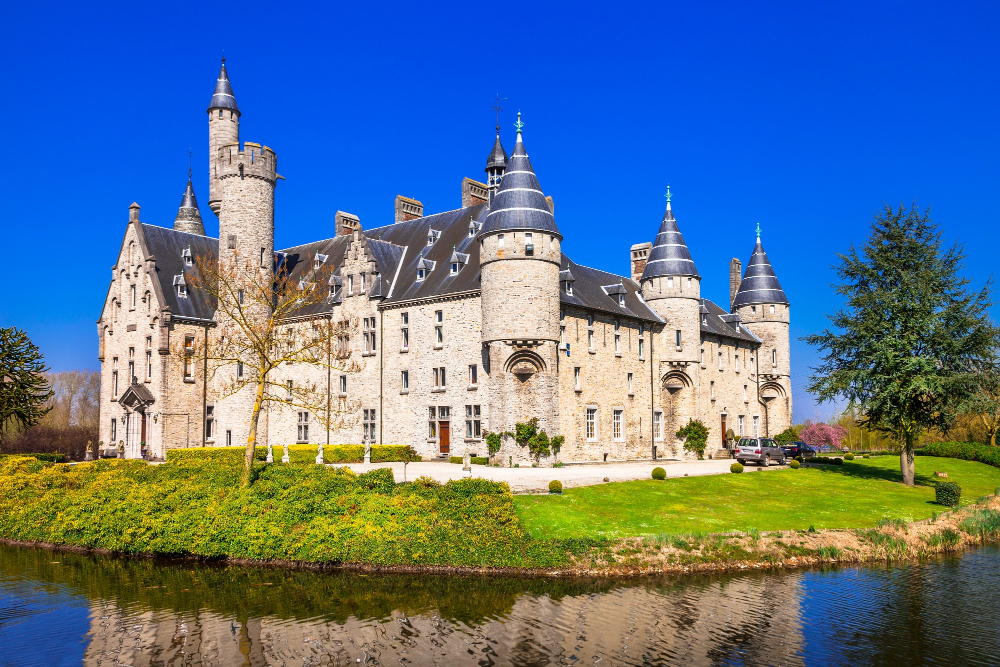
Set amidst the green countryside of the Belgian province of Antwerp, Bornem Castle—known as ‘Marnix de Sainte-Aldegonde Castle’—rises majestically. This impressive estate is not only an architectural masterpiece, but also a silent witness to centuries of history, marked by myths, legends and historical events. The castle’s history dates back to the Middle Ages, and its development reflects the changes and challenges Europe has faced over the centuries.
The Beginnings: A Fortress Against the Vikings – The first traces of human settlement at this site date back to the 10th or 11th century. At that time, a fortress was built here to protect the region from attacks by the notorious Vikings, who were known for their brutal raids. Strategically situated on a tributary of the Scheldt, the fortress offered both panoramic views and protection. The ‘Oude Schelde’, an old arm of the Scheldt, served as a natural line of defence, making the site ideal for a military installation. However, it was not merely a time of defence – the region around Bornem gradually developed into a centre for trade and agriculture, attracting both nobles and merchants. As the Viking threat waned over the centuries, the fortress lost its significance, yet its site remained and was later utilised for new construction projects.
A Spanish Baron and the Origins of the Manor House – The next significant changes took place at the end of the 16th century. In 1587, Pedro Coloma, a Spanish nobleman and Baron of Bornem, had a manor house built on the old foundations of the fortress. Coloma was a close confidant of Alessandro Farnese, the Duke of Parma, who at that time played a central role in the conflicts between Spain and the rebellious Netherlands. Thanks to Coloma’s influence, the castle became not only a private retreat but also a centre of political power and diplomatic activity. The construction of the manor house was inspired by an architectural style that combined elegance and robustness – a symbol of the Coloma family’s strength and influence in the region. However, the manor house did not remain in their hands forever: Over time, the estate changed hands several times and was eventually acquired by the Marnix de Sainte-Aldegonde family, who have maintained and preserved it ever since.
Revolution and Reconstruction: The Emergence of the Present-Day Castle – The Marnix de Sainte-Aldegonde family officially took over the estate in 1773. At that time, Europe was marked by political and social upheaval, particularly due to the Enlightenment and the impending French Revolution. Whilst many historic buildings were destroyed during this turbulent period, Bornem Castle survived – albeit in a state that later required extensive renovation. At the end of the 19th century, the castle was completely rebuilt under the direction of the architect Hendrik Beyaert. Beyaert was renowned for his ability to blend old architectural styles with modern approaches, thereby giving the castle a new identity. The building was given a neo-Gothic appearance that both honours the spirit of the past and meets the demands of the present. Many of the original 16th-century elements were removed, yet the character and history of the place remained alive.
Famous Residents and a Counts’ Dynasty – The list of the castle’s residents reads like a chronicle of aristocratic power and influence. The Coloma family, the estate’s original owners, produced several prominent figures, including Jean-François Coloma, the first Count of Bornem, and later his descendants, who further expanded the estate. After the castle passed to the Marnix de Sainte-Aldegonde family, a new era began. Claude-François de Marnix, the seventh Count of Bornem, took over the estate and laid the foundations for his family’s long association with the castle. From generation to generation, the titles and legacy were passed down, making the family an important part of Belgian history to this day. The current owner, John II de Marnix de Sainte-Aldegonde, represents this long line of nobility and preserves the castle’s traditions and stories.
Myths and legends surrounding the castle – Like any historic building, Bornem Castle also harbours its secrets. There are tales of ghosts said to wander the corridors and of treasures hidden in the depths of the castle. One legend claims that a former member of the Coloma family had a secret tunnel built beneath the castle, leading directly to the Scheldt – possibly as an escape route in the event of an attack. Other local tales speak of nocturnal apparitions, strange noises and a mysterious woman in white who is said to have been seen on the riverbank. To this day, these stories attract the curious and history enthusiasts seeking answers and savouring the castle’s mysterious atmosphere.
A cultural heritage for the future – Today, the castle serves not only as a private residence but also as a cultural symbol of the region. It stands as a testament to Belgium’s turbulent history, evoking the eras of the Vikings, Spanish rule and the political upheavals that have shaped the country. Many of its rooms have been preserved in their original style, complemented by modern restorations that maintain the building’s character. Although it is not regularly open to the public, guided tours and events are occasionally held, allowing visitors to discover the castle’s history and architecture. It is a place that bridges the past and the present, and whose significance extends far beyond its walls.
Bornem Castle is more than just a historic building – it is a living testament to Belgium’s cultural and social development. From its humble beginnings as a fortress against foreign invaders, through the heyday of the Spanish nobility, to its modernised 19th-century version, the castle tells a story of change, resistance and preservation. The myths and legends surrounding the estate lend this already fascinating place a mystical dimension and make it an inexhaustible source of inspiration – for historians and architects alike, as well as for history enthusiasts. Even though the days of knights and barons are long gone, Bornem Castle remains a place whose walls echo with the voices of the past. It reminds us that history is not only written in books, but also carved in stone – ready to be read by those who look closely.