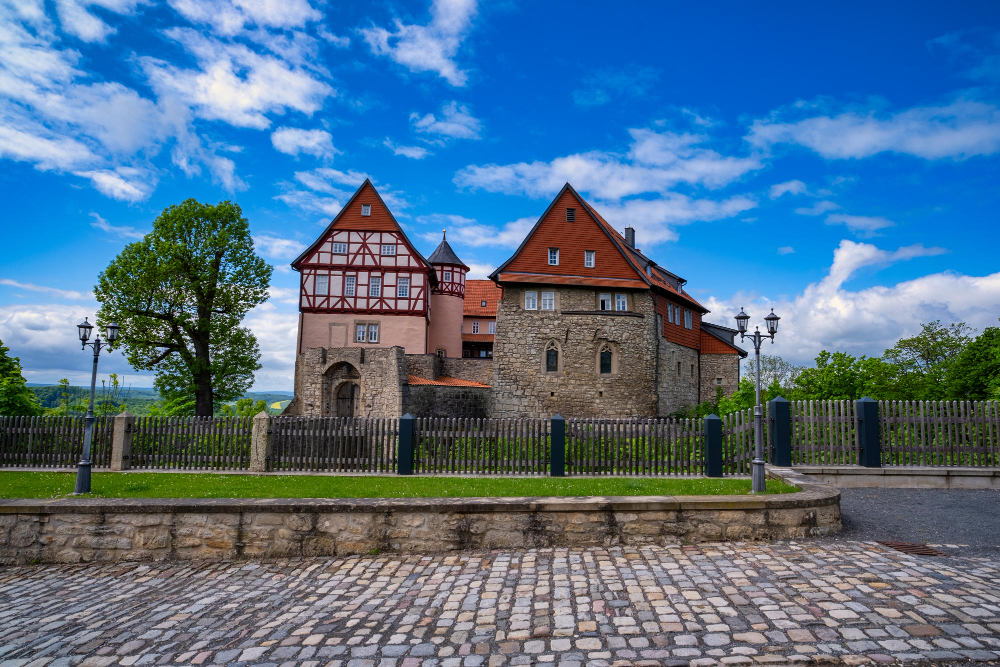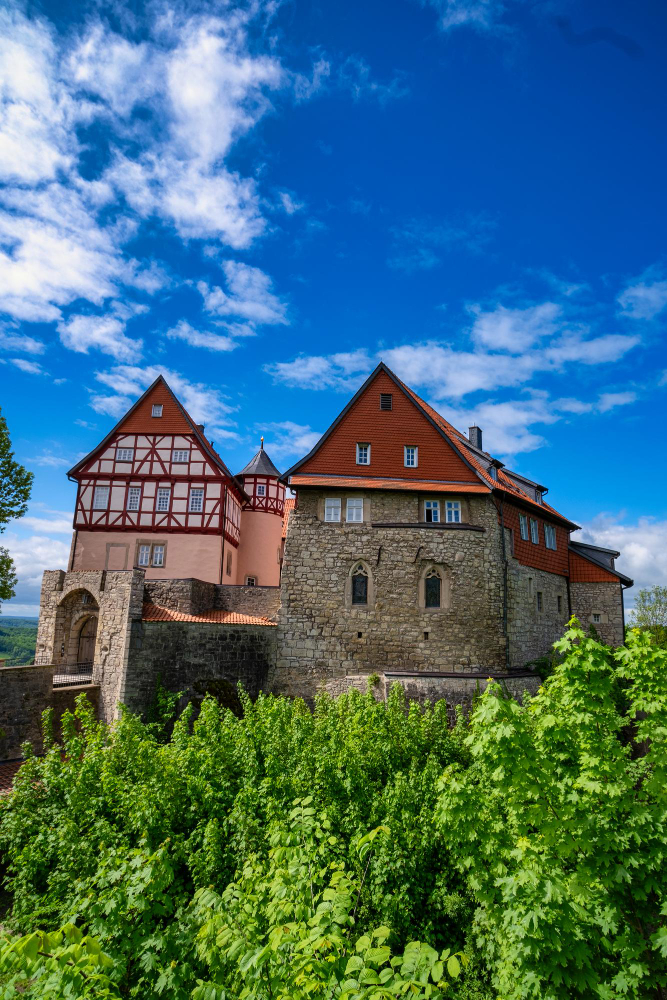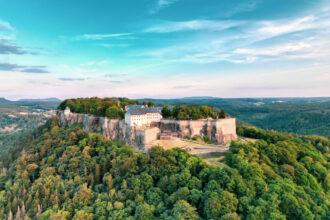
Bodenstein Castle, which towers majestically above the Thuringian village of Wintzingerode in the Eichsfeld region, is one of the best-preserved medieval castles in the area. Its stone walls tell tales of power, betrayal, love and resistance that have unfolded over the centuries. Nestled in the picturesque Ohm Mountains and surrounded by green forests, it is not only a cultural and historical monument but also a living place that uniquely connects the past and the present.
A border post between the tribes – Originally situated on a hill, the castle likely served as a border fortress between the Saxons and the Franks and was strategically expanded under the early Saxon emperors. Henry I, known as Henry the Fowler, reinforced the complex to ward off the threat of invading Hungarians. Later, the castle came under the control of Count Otto of Northeim, a central figure in the Saxon nobility’s resistance against Emperor Henry IV. The first mentions of a dynasty of the von Bodenstein family, which presumably emerged from the Northeim line, date from this period. Their name bears witness to their close connection to the castle, which became their ancestral seat.
Rise and Fall of the Lords of Bodenstein – The von Bodenstein family enjoyed its heyday in the High Middle Ages and, among other things, founded Beuren Abbey in the Leine Valley, a sign of their regional influence. However, over the course of the 13th century, the family’s power waned, and control of the castle changed hands several times: it passed from the Guelphs to the Counts of Honstein before finally coming into the possession of the Lords of Wintzingerode. The latter were to play a defining role in the centuries that followed.
Tragedies within the walls – One of the most tragic episodes in the castle’s history occurred in 1575, when Berthold XI of Wintzingerode was sentenced to death and beheaded following a series of political intrigues and personal disputes. Among other things, the conflict was triggered by his feud with relatives from the Scharfenstein branch. The verdict and the castle’s subsequent fate were shaped by power struggles between the Catholic feudal lords of the Electorate of Mainz and the Protestant Wintzingerodes. Later generations of the family also did everything in their power to preserve the castle and the surrounding lands despite religious and political constraints.
The Reformation and the Thirty Years’ War – Another chapter in the history of Bodenstein is the beginning of the Reformation. From 1530 onwards, the Lords of Wintzingerode officially introduced Protestantism into their domain, which increasingly brought them into conflict with the Catholic rulers. The turbulent period of the Thirty Years’ War, in turn, strengthened the Protestant faith in the Untereichsfeld region and established the family as important supporters of the Protestants.
The Duchess and the Steward – a romantic episode – An unexpected highlight in the castle’s history occurred in the late 18th century, when the widowed Landgravine Philippine of Hesse-Kassel, a niece of Frederick the Great, found refuge and love here. Her relationship with Count Georg Ernst Levin von Wintzingerode, her chief steward, initially led to a scandal, but later to a morganatic marriage. Under Philippine, the castle was enriched with works of art and furniture from the collection of the Prussian royal family, making it a cultural centre of its time.
Resistance to Oppression – The Role of the Confessing Church – A century later, during the dark years of National Socialism, Bodenstein became a centre of church resistance. Under Countess Gisela von Wintzingerode, who was active in the Confessing Church, the castle offered refuge to numerous opponents of the regime. This courageous stance once again underlined the characteristic spirit of the family, which had always fought against oppressive forces, be they political opponents or religious constraints.
From an aristocratic residence to a meeting place – The dramatic events of the Second World War and the subsequent land reform led to the expropriation of the Wintzingerode family without compensation in 1945. Yet the castle soon found a new purpose. The Evangelical Church in Central Germany took over the estate and developed it into a family retreat. Today, the castle provides a venue for cultural events such as castle concerts and cabaret evenings, whilst also serving as a place for people to meet and reflect.
Legends and secrets surrounding Bodenstein – As with many old castles, Bodenstein is also shrouded in legends and secrets. One particularly striking tale concerns secret escape routes said to run deep beneath the castle. Historians have so far been unable to find any evidence of their existence, yet the stories continue to capture the imagination of visitors. The von Wintzingerode family crypt, hidden in the woods below the castle, is also a mystical place. Thanks to extensive restoration work, the crypt, which had been damaged by vandalism and the forces of nature, has been restored. Today it stands as a silent testament to the long history of a family that shaped Bodenstein through wars, political intrigues and religious upheavals.
A place of history and the future – With its imposing walls, winding interior and picturesque chapel, Bodenstein Castle remains a place steeped in history that unites the past and the present. Visitors can now explore it on guided tours that offer a vivid insight into its nearly thousand-year history. For those wishing to stay longer, there are even accommodation options – a unique experience that deepens the connection to this historically significant place. Bodenstein Castle is more than just a historical monument; it is a symbol of resilience in the face of adversity, of the connection between different eras, and of the power of memory. Those who visit it do not merely enter a castle, but walk in the footsteps of countless people whose stories intersected and unfolded here in the shadow of its walls.