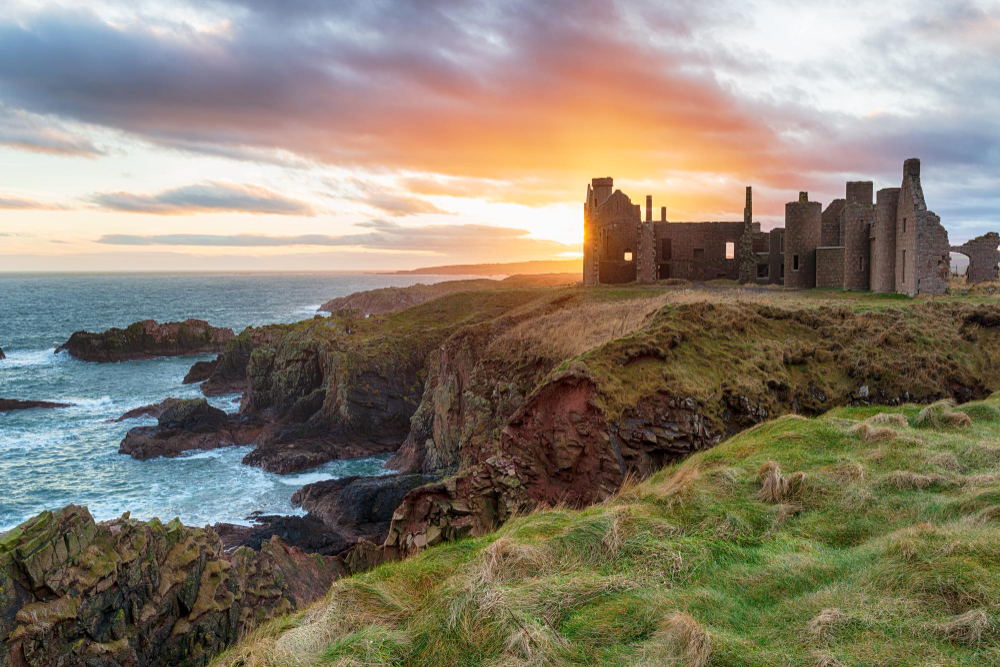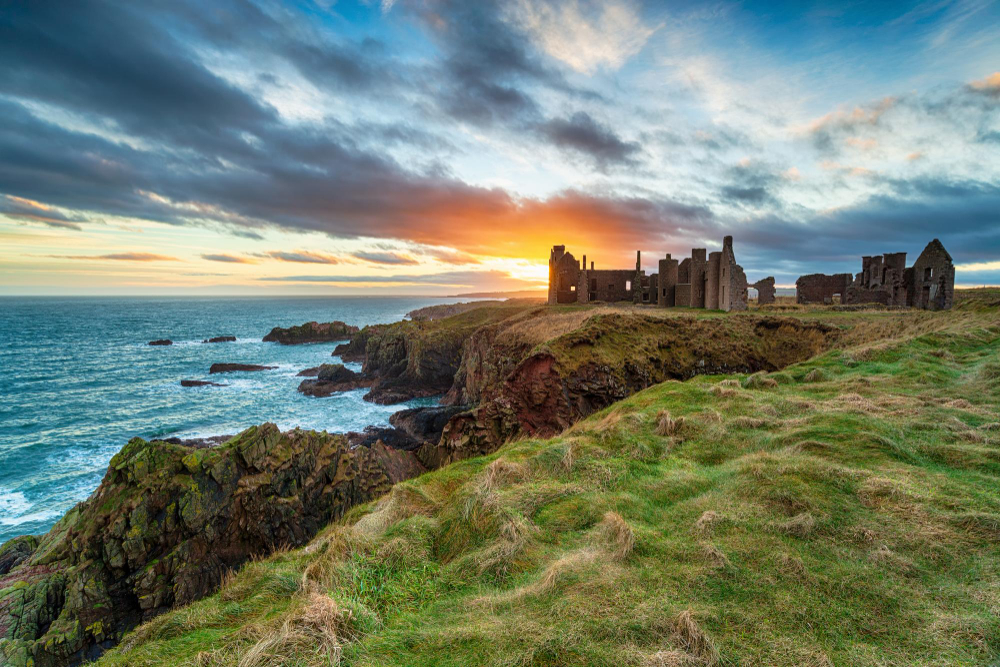
High above the cliffs of the Scottish North Sea coast stands a majestic structure that bears the marks of an eventful past: Slains Castle. Once the seat of powerful noble families, now a crumbling ruin – this place is not only a testament to historical events, but also a source of inspiration for literary masterpieces and the setting for mystical legends. Let us delve into the fascinating history of this castle, which captivates both historians and lovers of romantic tales alike.
The Beginnings: Betrayal and Destruction – The origins of Slains Castle are closely linked to the fate of the Hay family, whose influence in the Aberdeenshire region dates back to the 14th century. Whilst the family originally resided at nearby Old Slains Castle, a series of dramatic events was to change this. Francis Hay, the 9th Earl of Erroll, converted to Catholicism in the 16th century and became embroiled in a conspiracy against King James VI. His involvement in the ‘Spanish Blanks’, a secret pact to support Catholic interests, led to him being declared an outlaw and, ultimately, to the destruction of Old Slains Castle in 1594. Francis Hay, who renounced his faith upon his return from exile, soon began building a new family seat – a tower house on the cliffs of Cruden Bay. This new structure, originally known as ‘Bowness’, served as a refuge for the family and laid the foundations for what is now New Slains Castle.
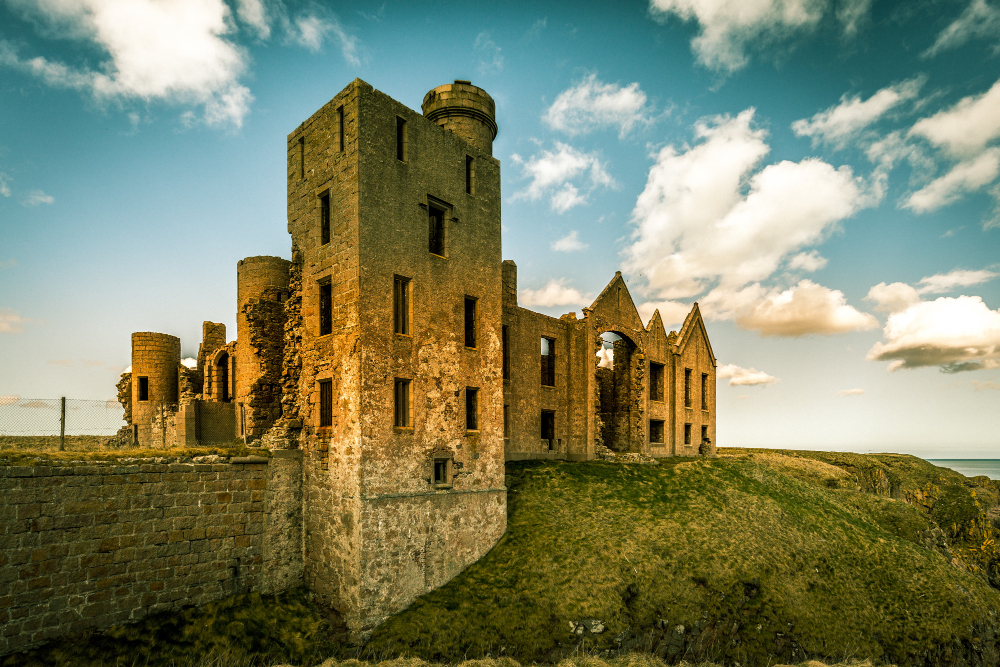
Architectural Development and Expansion – Over the centuries, the castle was repeatedly extended and remodelled. Of particular significance was the remodelling in 1837, when the architect John Smith redesigned the building in the Scottish Baronial style. This architectural style, characterised by battlements, towers and decorative granite cladding, gave the castle a fairytale quality. In its heyday, Slains Castle boasted three magnificent gardens, the design of which was completed towards the end of the 19th century by the renowned landscape architect T.H. Mawson. Today, the castle presents itself as a blend of various architectural styles, ranging from rough medieval masonry to finely crafted granite façades. Yet the ravages of time have taken their toll: since it was abandoned in 1925, Slains Castle has been a roofless relic of days gone by.
A link to the Jacobites – Another fascinating aspect of Slains Castle’s history is its connection to the Jacobite uprisings, a series of political and religious conflicts in 17th- and 18th-century Scotland. Several members of the Hay family were passionate supporters of the House of Stuart and played an active role in attempts to restore the deposed monarchy. Lady Catherine Carnegie, the wife of the 11th Earl of Erroll, is said to have secretly smuggled messages between the Jacobite rebels and King James II before she was forced to flee into exile in France. Although the struggles and intrigues surrounding the Jacobites ultimately came to nothing, these events left a lasting mark on the history of Slains Castle. Rumour has it that, during the 1708 uprising, France even planned to land troops at Slains Castle – a plan that was thwarted by the arrival of British warships.
The literary influence: Bram Stoker and Dracula – What makes Slains Castle unforgettable for many, however, is its connection to literature. Bram Stoker, the famous author of the horror novel Dracula, was a regular visitor to Cruden Bay and was apparently inspired by the castle’s dramatic setting. Although the widely held claim that Slains Castle served directly as the model for Dracula’s castle has been refuted – Stoker began making his first notes for his work as early as 1890, long before he first saw Slains – there are nevertheless interesting parallels. One particularly striking detail is the so-called ‘Octagonal Hall’, an octagonal room in the castle, which may be reflected in the description of a similar room in Dracula. Stoker’s detailed descriptions of gloomy rooms and rugged coastal landscapes may have been inspired by the impressions he gathered during his stays in the area.
The decline of an impressive building – With the dawn of the early 20th century, Slains Castle began to lose its significance. Financial difficulties and high inheritance taxes forced Charles Hay, the 20th Earl of Erroll, to sell the castle. What followed was the slow decay of the once magnificent estate: the roofs were stripped, timber and stone were sold off, and the castle was systematically plundered. Today it stands as a sad reminder of lost splendour and grandeur. More recently, there has been discussion of a possible restoration of the castle, including plans to convert it into luxury holiday accommodation. However, financial challenges have so far prevented any progress, and so Slains Castle remains a romantic, albeit dilapidated, landmark on the Scottish coast.
Myths and Ghost Stories – Like many old castles, Slains Castle is steeped in legends and ghost stories. One of the most popular – albeit unfounded – tales claims that the ghost of Victor Hay, the 21st Earl of Erroll, still roams the ruins. Interestingly, however, this legend may well be based on a literary mix-up: Victor Hay wrote the novel Ferelith, in which a fictional castle called ‘Gowrie Castle’ serves as the setting for supernatural events. Although there is no concrete evidence that Slains Castle is actually haunted, the site’s mystical atmosphere is nonetheless palpable. The rugged cliffs, the crashing waves and the labyrinthine ruins provide ample food for the imagination – and make the castle a magnet for anyone fascinated by the mysterious.
A place full of magic and history – Slains Castle is more than just a ruin; it is a living part of Scottish history, the scene of political intrigue, literary inspiration and fascinating legends. With its impressive architecture and dramatic setting, it offers an unrivalled insight into the life and culture of bygone eras. Whether as a tourist destination, a subject of research or a source of romantic tales – one thing is certain: Slains Castle will continue to captivate people’s hearts and minds for years to come.