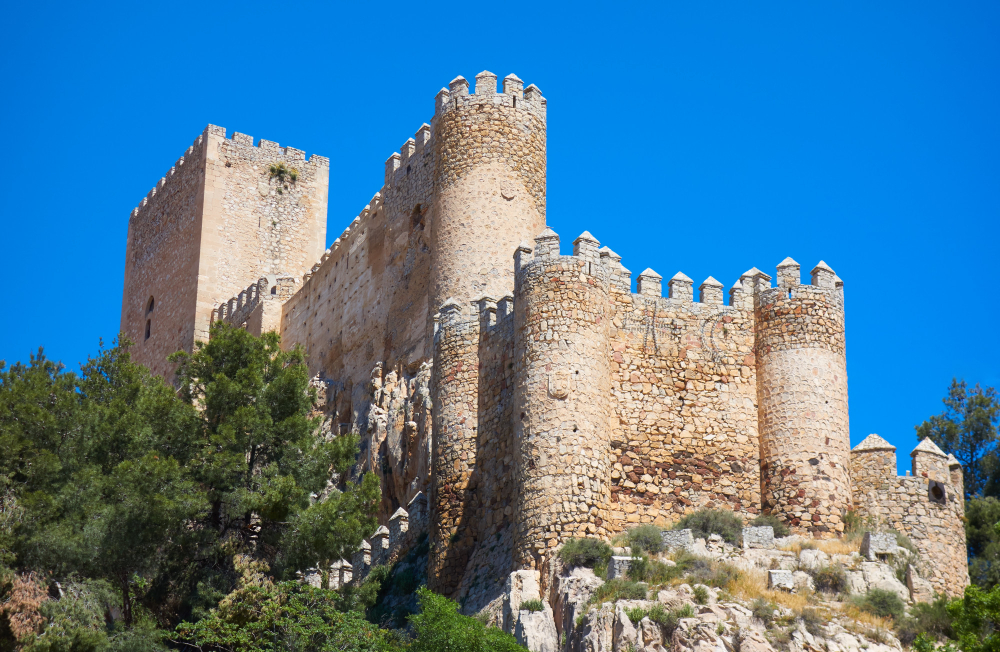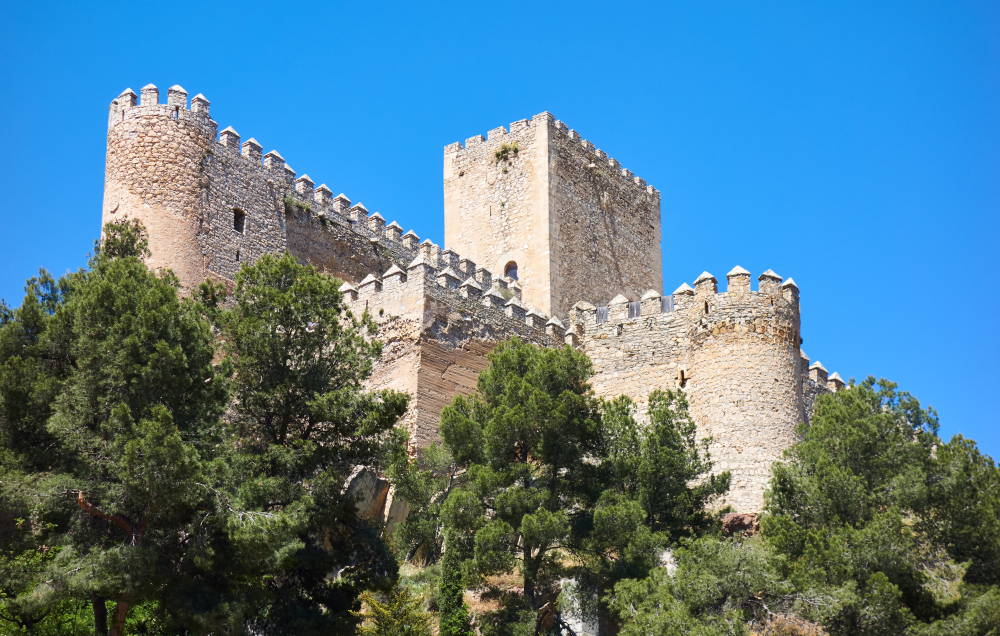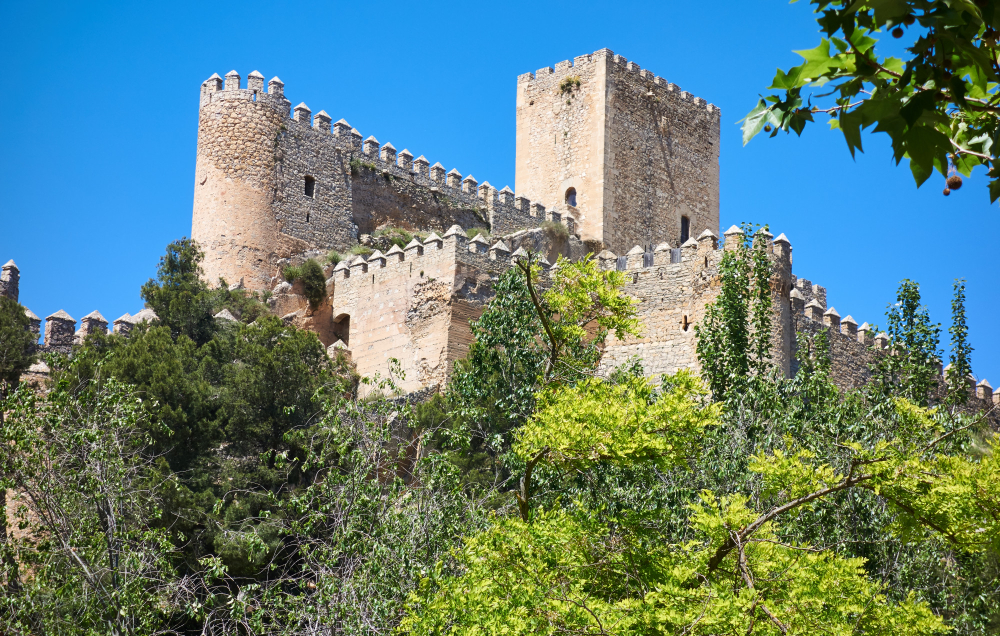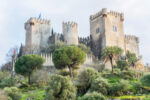
The imposing castle of Almansa rises majestically from a steep limestone cliff and has dominated the skyline of the town of Almansa in the Spanish province of Albacete, in the heart of the Autonomous Community of Castilla-La Mancha, for centuries. As a listed building, the Castillo de Almansa bears witness to an eventful history, architectural refinement and the fascinating fusion of different cultures that have left their mark on this region of Spain.
The Origins: A Moorish Military Complex and Border Fortification – The history of the Castillo de Almansa stretches back well before the 15th century. Originally, the striking limestone crag was home to one of the most significant Moorish military complexes in Spain. During Moorish rule, the castle formed part of a strategic defence system designed to secure the northern border of their sphere of influence. The castle’s geographical location – on an elongated, narrow rocky outcrop overlooking the plain – provided natural protection as well as an excellent view of the surrounding area, making it a perfect site for military purposes. The Moors, who were present on the Iberian Peninsula for almost eight centuries, built numerous fortresses to safeguard their territories. The Castillo de Almansa played a key role as a defensive stronghold against Christian attempts at reconquest (the Reconquista). Archaeological investigations and historical sources indicate that the castle’s original walls and fortifications were strongly influenced by Moorish architecture – a style characterised by robust construction, high walls and a skilful adaptation to the terrain.
The Reconquista and the 15th-century reconstruction – As the Reconquista progressed, the castle was eventually taken over by Christian rulers. In 1298, Don Juan Manuel (1282–1348), one of the most prominent nobles of medieval Castile, acquired the lordship (senorio) of Villena, which included Almansa and its castle. Don Juan Manuel was not only a feudal lord but also an influential writer and statesman who played a decisive role in shaping his estate in Almansa. Under his rule, the Castillo de Almansa underwent a radical redesign, which was modelled on the natural contours of the rocky terrain. This architectural adaptation gave the castle its characteristic, elongated shape, which nestles harmoniously against the narrow rock face. The reconstruction served both to strengthen the defences and to create stately living quarters that met the nobleman’s standards and tastes. Particularly striking is the keep (torre del homenaje) – a rectangular defensive tower which forms the tallest structure on the site and towers over Almansa, visible from afar. It served not only as part of the defences but also as a symbol of power and a place of refuge in times of emergency. The keep is connected to the other parts of the castle via narrow battlements running along both sides of the rock face, which enabled rapid defence and communication.
Architecture in detail: from the barbican to the palace – Access to the castle is ingeniously designed and historically began with a barbican – a forward-positioned, winding fortification that slowed down attackers and served as the first line of defence. This barbican was designed to follow the contours of the terrain, making it difficult to capture. Behind the barbican were several storehouses (almacenes), which served to store food and other goods – a guarantee of survival during sieges. Adjoining the storehouses was an armoury, which served as a gathering point for the castle’s inhabitants to arm and equip themselves. Swords, lances and other medieval weapons were stored here, ready to be seized quickly in the event of a defence. However, another key focus was the residential area, which served as a home for the nobles and their retinue. The Palacio, the actual residential complex within the castle, bears witness to the exacting standards of its inhabitants. Rooms for reception, administration and daily life are artfully arranged and offer an insight into the lives of the medieval nobility. Despite the castle’s military function, the palatial area places particular emphasis on comfort and status.
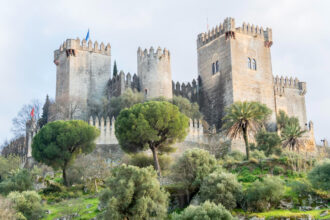
Restoration and Preservation of the Castle – Over the centuries, the Castillo de Almansa fell into partial disrepair, largely due to political upheavals and changing military circumstances. It was not until the 20th century that significant restoration work took place, saving the castle from further decay and making it accessible once more as a valuable piece of cultural heritage. Extensive restoration work was carried out in 1952 and again in 1990, during which, amongst other things, the entire crown of battlements on the walls was faithfully restored to its original state. These battlements – small, jagged projections from the walls – served as a protective shield for the defenders and are a typical feature of medieval castle architecture. The care and upkeep of the Castillo de Almansa are now the responsibility of the local authorities and heritage conservationists, who wish to preserve the building both as a tourist attraction and as a symbol of regional identity.
Legends and cultural significance – Like many historic buildings in Spain, the Castillo de Almansa is shrouded in legends and myths that enhance its mystical aura. It is said that secret passages are hidden deep within the walls, which served as escape routes in times of need or concealed treasures. Ghost stories about alleged apparitions of former knights and ladies of the castle also contribute to the mysterious atmosphere, although there is no historical evidence to support them. Culturally, the castle is an important part of the identity of the town of Almansa and its inhabitants. It stands as a symbol of the turbulent history marked by alternating Christian and Moorish rule and documents the transition from the Middle Ages to the modern era. Annual events, guided tours and historical re-enactments offer insights into life at the castle and bring history to life.
The Castillo de Almansa in the context of Spain’s castles – Almansa Castle is one of the most significant fortifications in Castilla-La Mancha and, due to its location and construction, represents an outstanding example of medieval military architecture. Compared to other castles in the region, such as Peñafiel Castle in Valladolid or the Alcázar of Segovia, the Castillo de Almansa is distinguished by its unique rocky setting and its careful integration into the natural landscape. The combination of its Moorish foundations and its Christian-medieval alterations makes the castle a significant testament to Spain’s cultural and historical diversity.
A masterpiece of history and architecture – The Castillo de Almansa is far more than mere ruins or a tourist attraction. It is a living testament to an era in which cultures merged in a remarkable way and political boundaries were redrawn through wars and diplomacy. The castle tells a story of power, war and life on the fringes of the medieval world – set against the fascinating landscape of Castilla-La Mancha. Thanks to careful restoration and growing interest in cultural heritage sites, the Castillo de Almansa remains a treasure that offers visitors the chance to immerse themselves in history and admire the art of medieval architecture. For lovers of history, architecture and legends, a visit to this venerable fortress is an unforgettable experience that brings Spain’s past to life.