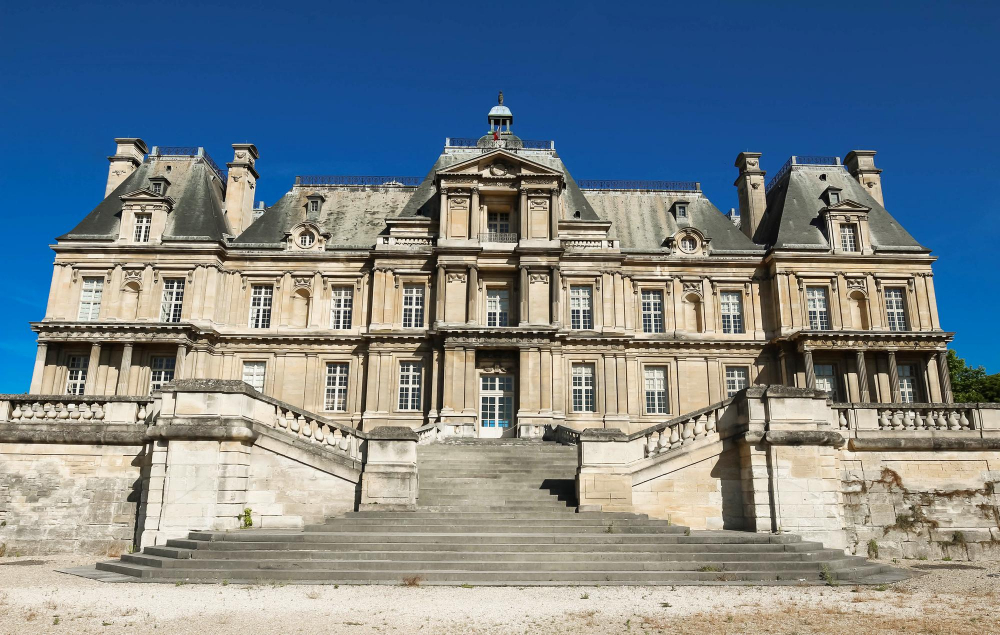
In the heart of the French commune of Maisons-Laffitte, nestled within the picturesque countryside of the Yvelines department in the Île-de-France region, stands an impressive 17th-century treasure – the Baroque Maisons-Laffitte Castle. Its extraordinary architectural style, its eventful history and the fascinating anecdotes surrounding its construction and its owners make it an unforgettable landmark. But what makes this château so unique? How has it survived the centuries and remained almost unchanged to this day?
A Dream in Stone: The Origins of the Château – The history of the Château de Maisons-Laffitte begins with René de Longueil, a high-ranking official and President of the Parliament of Paris. He dreamed of a summer residence that would not only symbolise his power and wealth but also herald a new era of French Baroque architecture. To realise this dream, he commissioned none other than François Mansart, one of the most renowned architects of his time. Mansart was granted complete creative freedom in the design, a rare exception in 17th-century France. Between 1642 and 1651, the Château de Maisons-Laffitte was built as a masterpiece of the transition from Italian-influenced Baroque to French Classicism. Particularly noteworthy is the harmonious fusion of traditional elements – such as the steep roofs and tall chimneys – with new, modern design features. The horseshoe-shaped floor plan and the precisely symmetrical design bear witness to Mansart’s genius. Famous figures such as the poet Charles Perrault later described the building as ‘one of the most beautiful things we possess in France’.
Power, splendour and loss: the changing owners – After its completion, the château was initially inhabited by René de Longueil. Following his death in 1677, however, a turbulent period began for the estate. It underwent numerous changes of ownership, each of which left its mark. Under the Soyécourt family and later under Charles Philippe, the brother of Louis XVI, the château enjoyed a luxurious heyday. But during the French Revolution, it was confiscated, its furnishings scattered, and the splendour of days gone by seemed lost. In the 19th century, a sense of stability returned when Marshal Lannes, a close confidant of Napoleon, acquired the château in 1804 and had it renovated. Napoleon himself stayed there regularly, which lent the château additional historical significance. Later, the banker Jacques Laffitte bought the estate and played a part in converting part of the surrounding parkland into building land. Under his nephew Charles Laffitte, the site even became the cradle of horse racing in France with the construction of the racecourse, which still exists today. Despite this use and numerous alterations, the château was never completely destroyed – a stroke of luck, as it was actually threatened with demolition at the beginning of the 20th century. The French state recognised its cultural value and acquired it, leading to its official designation as a ‘Monument historique’ in 1914. Since then, it has been open to the public and stands as a living testament to French architectural history.
Architectural masterpiece: the building and its details – The structure of Maisons-Laffitte Castle is impressive not only for its size, but also for its refined symmetry and wealth of detail. The main building, known as the Corps de Logis, forms the heart of the château. Its seven axes and the tower-like central risalit create an imposing effect. The side wings, which enclose a courtyard-like area, also contribute to its majestic appearance. Particularly striking is the orientation of the château: Whilst the main façade faces the present-day town of Maisons-Laffitte, the garden façade looks directly out onto the Seine. A horseshoe-shaped ornamental moat separates the château from the garden, whose Baroque forms and geometric path system are still recognisable today. Originally, the estate was surrounded by a sprawling Baroque garden, parts of which were later incorporated into the town. A spectacular vista even stretches for kilometres across the Seine.
From Baroque to Empire: A glimpse inside the château – The interiors of the Château de Maisons-Laffitte reflect the building’s eventful history. Each room seems to capture its own era, with styles ranging from the Baroque of Louis XIII to the Neoclassical Empire. Particularly impressive are the artfully crafted details such as paintings, reliefs and magnificent furniture. The entrance hall on the ground floor, with its Doric columns and bas-reliefs, is a prime example of the interplay between art and architecture. It provides access to other rooms such as the Prisoners’ Salon, whose fireplace was decorated by Gilles Guérin in honour of Louis XIII. The ballroom on the first floor, with its Italian barrel vault and original wooden parquet flooring, also offers a glimpse into the extravagant festivities of the 17th century. The famous Grand Staircase, consisting of four flights of stairs, is a technical masterpiece of 17th-century French architecture. It appears almost weightless, as it was designed using stereotomy techniques.
Source of inspiration and global influence – Maisons-Laffitte Castle is not only of local significance but also serves as a source of inspiration internationally. One example is the Château de Franconville in the Val-d’Oise department, the construction of which was heavily influenced by Maisons-Laffitte. There is even an architectural echo in Buenos Aires: Plaza Constitución railway station bears stylistic similarities to the castle. Surprisingly, the château was also almost exactly replicated in China. Property developer Zhang Yuchen spent 300 million US dollars to build the so-called Château Beijing Laffitte, which is now operated as a luxury hotel. This global imitation underscores the universal recognition of Maisons-Laffitte as an architectural masterpiece.
A Living Monument – Today, Maisons-Laffitte Castle stands as a symbol of the splendour of bygone eras and the creative power of French architecture. Its eventful history and impressive architecture make it a popular destination for visitors from all over the world. It has been a listed building since 1914 and hosts temporary exhibitions that preserve its cultural heritage. Maisons-Laffitte Castle is not merely a building, but a living testament to French history – full of secrets, legends and inspiration. It invites us to travel back in time and discover the stories behind its walls. Anyone strolling through the courtyard of honour or letting their gaze wander over the Baroque garden will undoubtedly sense that this is more than just a château – it is part of the soul of France.