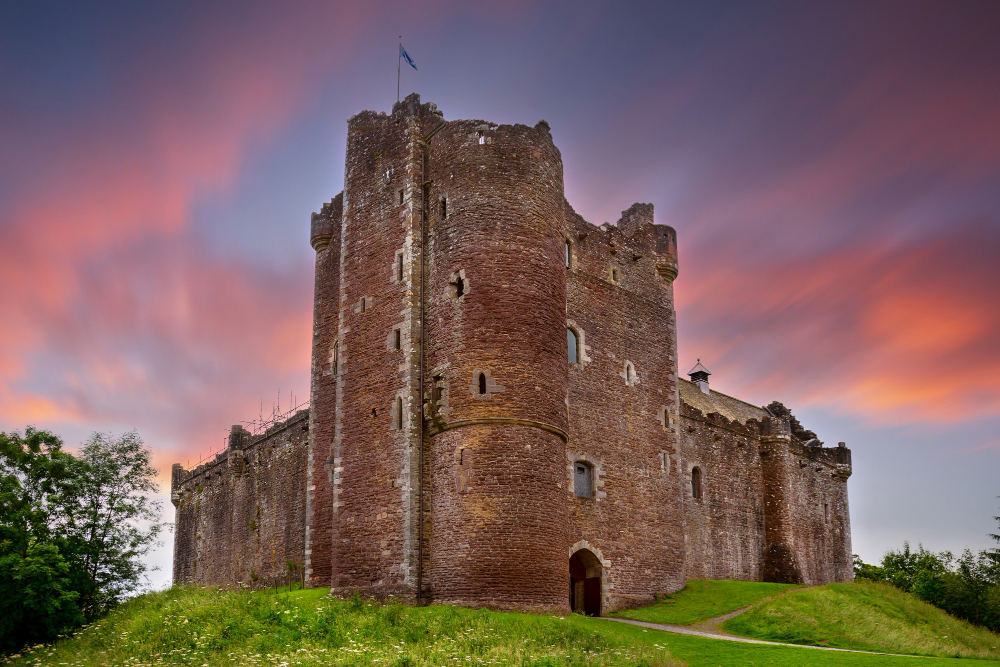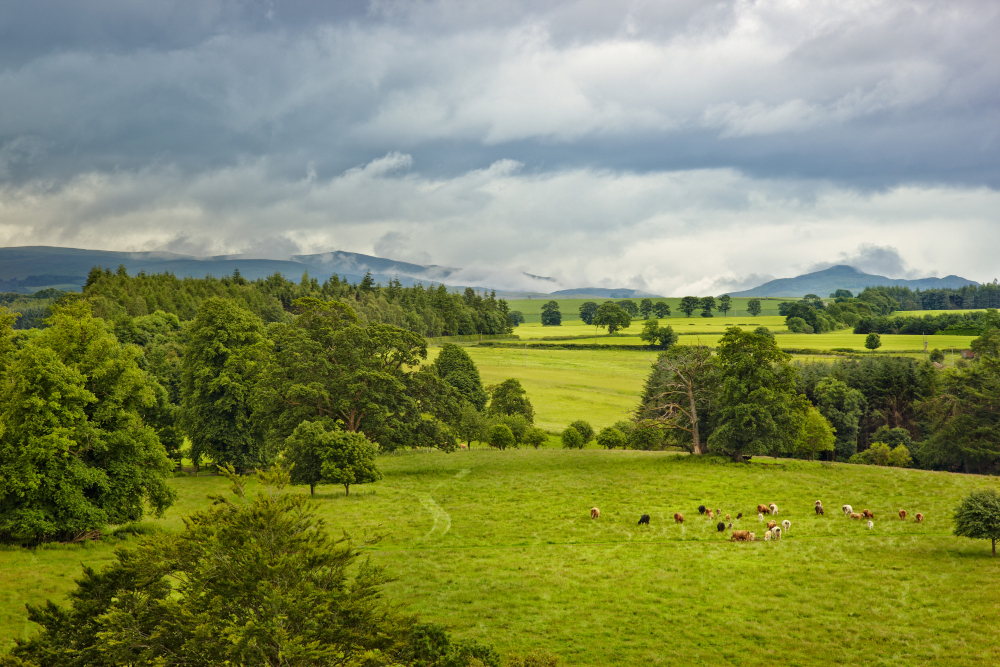
In the Scottish Highlands, picturesquely situated on a rocky outcrop overlooking the River Teith and nestled amongst the rolling hills of the Trossach Mountains, stands Doune Castle – a late medieval castle that fascinatingly blends history and fiction. Just 13 kilometres from Callander, this structure not only attracts tourists but also tells tales of epic battles, royal hunting expeditions and cinematic masterpieces. Today, Doune Castle is a popular destination for history buffs, architecture enthusiasts and fans of legends and stories alike.
The historical development of a building – The origins of Doune Castle can be traced back to 1390, when Robert Stewart, the first Duke of Albany, is thought to have had the castle built on the foundations of an older fortress. Robert Stewart was a powerful man of his time: As the son of King Robert II, he wielded great influence in Scotland and acted as the country’s de facto ruler after his brother, King Robert III, was severely incapacitated by illness. His power and wealth are reflected in the imposing architecture of Doune Castle, which served both as a stately residence and a strategic fortress during his lifetime. Over the centuries, the castle has been used and altered on numerous occasions. Of particular note is its significance in the 15th and 16th centuries, when it was frequently visited by Scottish monarchs. Mary, Queen of Scots, one of the most famous figures in Scottish history, used Doune Castle as a country estate and hunting lodge. During the Jacobite uprisings of 1745, the site returned to the limelight: this time, the Jacobites turned the castle into a prison for their political opponents. However, following the unrest of the rebellion, Doune Castle lost its importance and fell into increasing disrepair. It was not until the 19th century that extensive restoration work began to save the castle from complete ruin. These efforts have helped ensure that Doune Castle is now one of the best-preserved medieval structures in Scotland. The castle is managed by Historic Scotland, a government heritage organisation, which has opened it to the public. With thousands of visitors each year, Doune Castle is now one of the country’s most popular attractions.
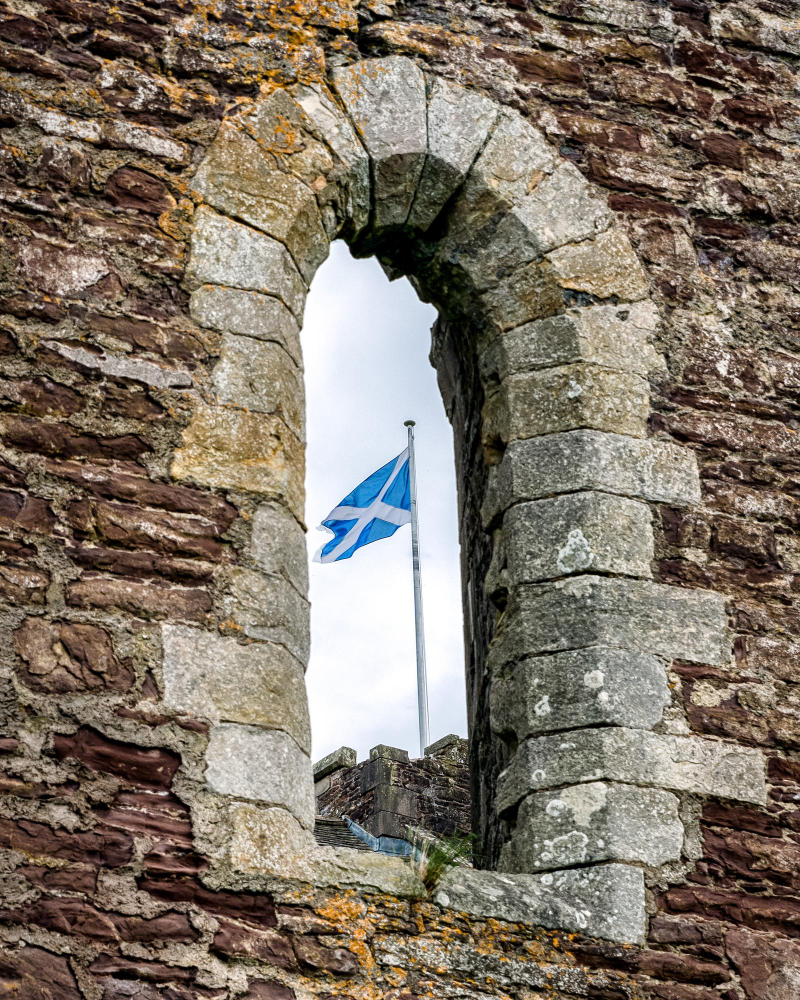
An architectural masterpiece – Doune Castle is impressive both for its architecture and its location. Surrounded on three sides by steep slopes, the castle once offered natural protection against attackers. Access from the north was further secured by earthworks, which further strengthened its defences. At the heart of the complex lies a spacious inner courtyard, enclosed by high walls and surrounded by various buildings. The most striking structure within the castle is undoubtedly the residential tower, the ‘Lord’s Hall’, which, at a height of 30 metres, dominates the entire complex. The four-storey tower houses not only living quarters but also state rooms. An impressive, vaulted gateway, 14 metres long, runs through the ground floor of the tower; this once served as the main entrance to the castle. Another highlight is the Great Hall, which captivates with its simple elegance and functionality. Thanks to its size, it provided space for lavish banquets, political gatherings or courtly ceremonies. Right next to it is the kitchen, which is also part of the building complex and underlines the castle’s importance as a centre of social life. One detail that sets Doune Castle apart from other Scottish castles, however, is the fact that the complex was never fully completed. Although it is impressive even in its unfinished state, it bears witness to how ambitious building projects can sometimes be brought to a standstill by political or economic circumstances.
Myths and Legends: Walter Scott and the Jacobites – Doune Castle is not only a place of historical facts, but also the setting for numerous myths and stories. In Sir Walter Scott’s first novel, Waverley, published in 1814, the castle is mentioned and plays an important role. The protagonist, Edward Waverley, seeks refuge here whilst becoming embroiled in the turbulent events of the Jacobite Rising. Walter Scott, himself an avid admirer of Scottish history, helped, through his writings, to bring the romance and mystique of places such as Doune Castle to a wider audience. The events surrounding the Jacobite Rising also lend the castle a special charm. During this period of Scottish history, Doune Castle was not only a strategic stronghold but also a symbol of resistance against the British Crown. Many legends and stories surround the castle’s use during this time, some of which are still recounted by locals to this day.
Doune Castle on screen: from Monty Python to Game of Thrones – As well as its historical significance, Doune Castle has also secured a firm place in the world of film and television. One of the best-known productions filmed here is the film Monty Python and the Holy Grail by the English comedy group Monty Python. The castle served as a backdrop on several occasions: it stood in for Camelot, Castle Anthrax and Swamp Castle, which not only delights fans of absurd humour but has also made Doune Castle famous worldwide. Another highlight is the US fantasy series Game of Thrones, in which the castle served as the filming location for Winterfell, the home of the Stark family. Here, with its medieval walls and authentic ambience, Doune Castle creates precisely the atmosphere required for the series’ epic scenes. The adaptation of Diana Gabaldon’s novel Fire and Stone, better known as Outlander, also used the castle as a setting. In the series, Doune Castle stands in for the fictional Leoch Castle, a key location in the plot. Thanks to these prominent appearances in film and television, Doune Castle has secured a place in contemporary pop culture and attracted new streams of visitors who are fascinated less by its history than by the castle’s cinematic past.
A multifaceted place – Doune Castle is far more than just a medieval castle. It is a place where history comes to life, where myths and legends find their place, and where the magic of film becomes tangible. Whether as the country residence of Mary, Queen of Scots, as a prison for the Jacobites, or as a setting for Monty Python and Game of Thrones – the castle brings together many different facets and reflects the diversity of Scottish culture. With thousands of visitors each year, Doune Castle remains a vibrant place that bridges the gap between history and the modern day. It is a must-see for anyone travelling through the Scottish Highlands who wishes to be enchanted by the aura of times gone by. From the castle’s steep walls to the stories told in their shadow – Doune Castle is a place that captivates every visitor.