The Hanseatic town of Rees, situated on the Lower Rhine, is a place full of historical secrets and fascinating legends. It is one of the oldest towns in the region and has undergone an impressive evolution over the centuries – from the first traces of human settlement to the modern town of today. Yet behind its picturesque façade lie stories that reach deep into the past and are shaped by historical events.
From the Stone Age to Frankish settlement: the first evidence of an eventful past – The first evidence of life in the area of present-day Rees dates back to the Neolithic period, more than 4,000 years ago. During construction work on the A3 motorway in 1961, fragments of cups and daggers were discovered on the Colettenberg near Haldern, which had served as grave goods. These finds provide valuable insights into the way of life of the people of that time. Later, archaeologists came across the remains of a settlement from the Hallstatt period (800–450 BC), evidence that the area was settled at an early stage. Between 500 and 800 AD, a Frankish settlement was established on a hill known as the ‘Ward’. The name ‘Rees’ is thought to derive from the Old Norse term ‘Rys’, meaning ‘willow grove with reeds’. Another significant event of this period was the Christianisation of the Lower Rhine by the Anglo-Saxon monk Willibrord between 695 and 739. Around 700, one of the region’s first churches was built in Rees, underscoring the town’s early importance.
The founding of the medieval town and its heyday – The town of Rees was actually founded in the High Middle Ages. Around the year 1000, Aspel Castle was first mentioned in a document, and around 1040, Irmgard von Aspel had a new church built in Rees over her parents’ graves. This became the centre of a canonry, which later even housed a Latin school. The decisive turning point, however, came on 14 July 1228, when the Archbishop of Cologne officially granted town privileges to the settlement, which had around 600 inhabitants and some 150 buildings. This made Rees the oldest town in the Lower Rhine region. A significant milestone was the construction of the town wall, which began in 1289 and was completed around 1350. This imposing structure not only offered the town protection but also a sense of self-confidence. The economic boom during this period enabled further building projects, including the Gothic town hall, the construction of which was completed around 1450.
A theatre of military conflict in the modern era – The modern era brought both progress and challenges for Rees. In 1549, the town experienced a dark episode when the magistrate expelled the Jewish population. Shortly afterwards, in 1571, a Protestant congregation was first mentioned in Rees. Rees became a fiercely contested battleground during the Spanish-Dutch War. In 1598, the town fell under the control of Spanish troops, but following the death of the last Duke of Kleve, Johann Wilhelm (1609), and the Peace of Xanten, Rees passed to the Elector of Brandenburg in 1614. To secure this new acquisition, the Brandenburgers asked the Dutch for help; they subsequently occupied the town and built a large fortress between 1616 and 1625. Just as the town was beginning to recover from the fighting, it once again found itself at the centre of the conflict. In 1672, French troops under Marshal Turenne occupied Rees, before Brandenburg-Prussia regained control and razed the fortifications to the ground. Despite these upheavals, Rees managed to hold its ground and remained a strategically important location, particularly during the Seven Years’ War.
Challenges and Change in the 19th and 20th Centuries – The beginning of the 19th century brought significant changes for Rees. Following the Treaty of Schönbrunn (1806), the town became part of the Grand Duchy of Berg, which was under French control. During this period, Rees served as the administrative centre of a canton within the Arrondissement of Essen. Following Napoleon’s defeat at the Battle of Leipzig, the town returned to Prussian rule in 1813, a status confirmed by the Congress of Vienna in 1815. In the 20th century, Rees faced new challenges. At the start of the Nazi dictatorship, Jewish families were persecuted and deported. The Second World War left a deep mark: the town was almost completely destroyed in an air raid on 16 February 1945. The fate of the prisoners in the ‘Groin’ forced-labour camp was particularly cruel; they were forced to work under inhumane conditions. Over 10 per cent of the inmates did not survive this ordeal. The post-war reconstruction of the town was arduous, yet the resilience of its citizens helped to preserve its cultural heritage and rebuild Rees.
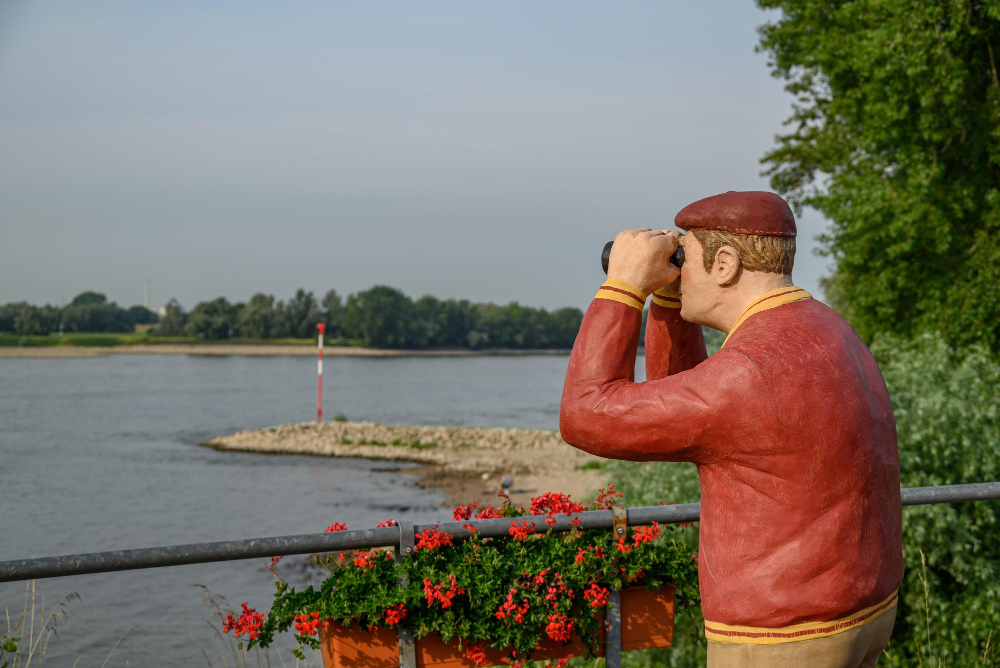
A town in harmony with the Rhine – A central aspect of Rees’s history is its relationship with the Rhine. Flooding, bank erosion and the formation of islands have shaped the lives of its inhabitants since time immemorial. A map by the cartographer Johann Bucker from 1713 shows just how strongly the area was once shaped by the river, with numerous small and large islands that no longer exist today. The ‘Reeser Schanz’ nature reserve, a former fortification, has since developed into a popular leisure and water sports centre. The Rhine remains a defining feature that continues to shape the town’s identity and character to this day.
Rees today: tradition and modernity in harmony – Today, the Hanseatic town of Rees presents itself as a harmonious blend of historical charm and modern life. Its long and eventful history, dating back to antiquity, makes it a unique place on the Lower Rhine. From the medieval fortifications to leisure activities on the banks of the Rhine, every corner of the town tells a story. Rees is a striking example of just how rich and fascinating the history of a small town can be. From the earliest traces of human settlement to the tragic events of the Second World War, the town remains a living history book – open to all who are willing to explore it page by page.